
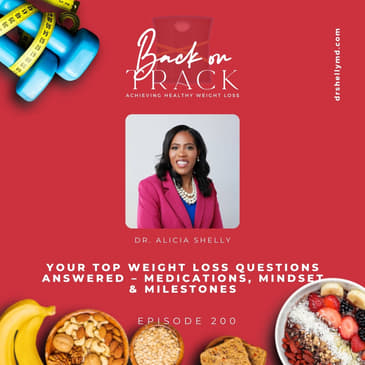
Episode 200 is a celebration of your journey and questions, as I dive deep into the realities of weight loss, medications, and staying consistent through it all.
In this episode, I celebrate a huge milestone—our 200th episode of the Back on Track: Achieving Healthy Weight Loss podcast! I take this opportunity to answer your most frequently asked questions from TikTok, YouTube, Instagram, and podcast listeners, covering a wide range of topics like weight loss medications (such as Qsymia and Contrave), combining medications, insurance, PCOS, managing side effects, and more. I also dive into important issues like long-term use of medications, how they affect hormones and metabolism, dealing with weight loss plateaus, and how shift work and mindset can impact progress. Furthermore, I share tips for staying consistent and remind you that small steps matter on this journey.
Celebrate 200 episodes of transformative weight loss advice with me and tune in now for expert answers to your most pressing health and weight loss questions!
Episode Highlights:
-
Frequently asked questions about weight loss medications like Qsymia and Contrave
-
Comparison between Qsymia, Contrave, and GLP-1 medications
-
Medication safety regarding Lexapro, alcohol, and pregnancy
-
Understanding PCOS and insulin resistance in weight management
-
Addressing muscle loss and weight plateaus during weight loss
-
Strategies to manage hunger with shift work and circadian rhythm disruptions
-
Overcoming the “all or nothing” mindset for long-term consistency and success
Connect with Dr. Alicia Shelly:
-
Website | drshellymd.com
-
Facebook | www.facebook.com/drshellymd
-
Instagram | @drshellymd
-
Linked In | www.linkedin.com/in/drshellymd
-
Twitter | @drshellymd
About Dr. Alicia Shelly
Dr. Alicia Shelly was raised in Atlanta, GA. She received her Doctorate of Medicine from Case Western Reserve University School of Medicine in Cleveland, OH. Dr. Shelly has been practicing Primary Care and Obesity medicine since 2014. In 2017, she became a Diplomat of the American Board of Obesity Medicine. She is the lead physician at the Wellstar Medical Center Douglasville. She started a weekly podcast & Youtube channel entitled Back on Track: Achieving Healthy Weight loss, where she discusses how to get on track and stay on track with your weight loss journey. She has spoken for numerous local and national organizations, including the Obesity Medicine Association, and the Georgia Chapter of the American Society of Metabolic and Bariatric Surgeons. She has been featured on CNN, Fox 5 News, Bruce St. James Radio show, Upscale magazine, and Shape.com. She was named an honoree of the 2021 Atlanta Business Chronicle's 40 under 40 award. She also is a collaborating author for the, “Made for More: Physician Entrepreneurs who Live Life and Practice Medicine on their own terms''.
Resources:
FREE! Discover the 5 Reasons Your Weight-Loss Journey Has Gotten Derailed (And How To Get Back On Track!) 👉 Click
[00:00:00] Welcome back to the Back on Track Achieving Healthy Weight Loss, where I help you get on track and stay on track with your weight loss journey. I'm your host, Dr. Alicia Shelly. So let's get started.
[00:00:27] Hello, and welcome back to the Back on Track Achieving Healthy Weight Loss podcast. I'm your host, Dr. Alicia Shelly. And today I can hardly believe it. We are celebrating a major milestone.
[00:00:41] Our 200th episode. Woo! I cannot believe that it has been almost 200 episodes. Whether you've been with me from Episode 1 or just recently joined our community, I just want to say a huge, a big thank you. Thank you.
[00:01:01] Thank you for just supporting me throughout this time. Thank you for your stories. Thank you for your questions, your determination. This is what keeps this podcast growing strong. To celebrate, I'm going to be doing something special. Something a little bit different than what I normally do. I'll be answering your most frequently asked questions characterized by topic from either my TikTok, YouTube, or Instagram and podcast listeners.
[00:01:29] We're covering everything from weight loss medications and hormones to insurance coverage and mindset. So let's dive in. So let's first talk about a pretty hot topic, which is quiesemia. This topic was under my ABCs of quiesemia topic of my video podcast. And at Aaron says, or asks, how long can a person stay on quiesemia? Great question, Aaron.
[00:01:58] The short answer is as long as you need it. And that's what I tell my patients. With these medications, this combination of fentramine and topiramate, they have been, fentramine has been out since the 1950s. And so topiramate has also been out for some time. So if the medication is curbing your appetite, allowing you to eat smaller portions and still allowing you to lose weight and maintain your weight, then it's okay to be on it long term. So you don't necessarily need to limit it.
[00:02:26] What studies are showing us as far as when it comes to maintenance of weight loss is that people still need something. The particular trial I'm talking about is the Sermount trial, Sermount 4 trial. This looked at terzepatide or ZepBound. And what it did, it had people who had been taking ZepBound for about 36 weeks, and then they switched them either to continue to take ZepBound or to stop it.
[00:02:52] And so what happened was those people who continued to take it for an additional year ended up continuing to maintain their weight and lose about 5% more from what they'd already lost at that 36 weeks. For those who stopped it, they regained on an average of 14% of their body weight. So what that tells us, and we're seeing this not just with the terzepatide or ZepBound, but we see this with other medications, is that you need something. Obesity is a chronic disease.
[00:03:21] And so we do probably need something to kind of help curb your appetite. What happens when you stop the medication is sometimes that hunger hormone starts to come back. You feel more hungry. You may find that you're eating more portions, and then you gradually start to gain the weight back. And so sometimes having something to kind of help suppress that appetite and to keep it down is helpful for people. So thank you, Erin, for your question. At DIAB asks, which one's better, Contrave or Cosemia?
[00:03:48] Now, I will say that each medication works differently. And so it just depends on what your problem is as far as whether it's like, are you having issues with cravings? Sometimes with the fentramine and topiramate, those people who are having issues with cravings, that can kind of help with that, help kind of bring those cravings down. Also for Contrave, it definitely helps at the level of the brain to decrease your appetite. So it really works well there.
[00:04:15] And if you are kind of also having some difficulties with drinking a lot of alcohol, things of that nature, it can help curb that as well. So it kind of does both. It just depends that they have about the same, I think Cosemia is a little bit more as far as average weight loss in the studies, but there's no head-to-head trial. So it's hard to really say. And I think you have to look at what's the phenotype of the person, you know, whether it's like their brain, it always tells them they're hungry or they feel like their stomach is always hungry.
[00:04:44] So it just kind of is the difference. And I guess I probably should do an episode on obesity phenotypes because everyone is completely different. And the other thing I would also say, it also depends on what kind of medical conditions you have. So Contrave would be better if you have like a heart disease, you know, atrial fibrillation, because it does not affect your heart. Whereas sometimes with that phentermine, it can cause your heart rate to go up. And if you have a history of atrial fibrillation, that can be a problem. That can make it a little bit worse.
[00:05:13] So that may be something to consider there. All right. Next question is from at Chloe and at Jay. And a couple of others had a question about combining quesemia with the GOP-1. And so that I would say, you know, what we're seeing now is that with that combination is that sometimes the GOP-1s were working really good to help people with curbing their appetite.
[00:05:39] They're eating smaller portions, but they're finding that their cravings are not necessarily completely controlled. And that's when you can add on quesemia because that tapiramate element can help reduce those cravings, especially at nighttime. So definitely talk with your doctor on whether that works for you, but you can combine it. There's not a current guideline on it currently.
[00:06:01] But when we talk with our leading experts in obesity, they're actually combining different medications to get more of an effect for the person in front of them for their patients. So I think that's fine. There also was a question about Lexapro and whether it's safe to take a quesemia with Lexapro. And currently Lexapro is not contraindicated with quesemia.
[00:06:26] Sometimes if you experience anxiety, phentamine can cause your heart rate to be higher, can sometimes cause your anxiety to be a little bit higher because it's a stimulant. So it's kind of stimulating you and you can feel a little bit more anxious if you already have that history of anxiety. And so you may want to kind of meet with your doctor and kind of have close monitoring to make sure you're okay with it. Also, there was a question about pregnancy concerns.
[00:06:51] So the actual question was, if the person is a male taking quesemia, do they need to worry if they're trying to get pregnant or conceive about their unborn child? If you are a male, you do not need to worry about that. Usually the pregnancy concerns is usually with females. And so for those who are unaware, with quesemia, the recommendation is to have a pregnancy test because it can cause birth defects.
[00:07:17] And so therefore, if you're trying to get pregnant, it's better to be off with semia before you do that. And it's important to kind of do a pregnancy test to make sure you're not pregnant before starting it. But definitely talk with your doctor too about the pregnancy concerns in Lexapro. All right. Now we're going to talk a little bit about contrave. So I received a lot of questions about that medication, about that podcast.
[00:07:40] And so user 1475080405879 asks, will contrave show up as a narcotic on a drug test? The answer is no. No, it won't. It's combined with bupropion or naltrexone. And so usually for a drug test, they're looking for narcotics like percocet, like opiates, oxycodone, hydrocodone, that type of thing. Morphine. Naltrexone is not a narcotic.
[00:08:09] Naltrexone is a medication we normally use to help people with curbing their appetite, with curbing their alcohol. But with that combination with bupropion, it kind of works at the brain to kind of help curb your appetite too. So it helps in that regard, but it will not be flagged on a test or drug test. All right.
[00:08:40] Usually with the memory loss, you don't see that as much. The most common side effects that we see with contrave are going to be that nausea, vomiting, sometimes headaches that people can experience. Definitely, if you experience those, you know, definitely talk with your doctor. Sometimes for my patients, I would prescribe medication for them, just anti-nausea, just to kind of help cut it out when it comes on. If it's something that's continuous, constant, then I would probably change the medication for them. How much weight should you expect in the first month?
[00:09:09] It actually does depend on the person. The one thing I would say is that the first month, you are actually tapering up on the medication. So you're going from first week, one tablet. Second week, one tablet in the morning, one tablet in the evening. Third week, two tablets in the morning, one tablet in the evening. Fourth week, two tablets in the morning, two tablets at night. Right. And so as your body is getting used to that medication, you know, it does take some time. You're not going to see as much weight that first month.
[00:09:36] So I really recommend my patients to give it at least a month to kind of see it working to help your appetite and then keep watching it as you go along. And people tend to do pretty well, do well with it too. So at Holly and at Stephanie asked about combining contrave with alcohol and other antidepressants. And so definitely my recommendation would be to actually reduce the alcohol that you're taking. Naltrexone can help with that. It kind of takes that alcohol craving out.
[00:10:04] I wouldn't necessarily take the medication with alcohol. I don't think that's healthy or any medication with alcohol, truth be told. Combining with other antidepressants. So if you're on another antidepressant, you want to kind of speak with your doctor about whether you can combine that bupropion. Bupropion usually is a class of itself. So sometimes we can add that on just in general when we're trying to treat somebody with depression.
[00:10:31] So you may have an SSRI, SNRI plus bupropion. But I would recommend speaking with your doctor just to make sure you're okay with that. And then somebody else asked about splitting the pill, whether you can cut that in half. I wouldn't necessarily recommend cutting it in half. Truth be told, I realize you're taking two tablets in the morning, two tablets at night. So that could be a lot of tablets, but definitely talk to your doctor about that. I do have some patients where they don't go up to the full two in the morning, two in the evening. They may just take one in the morning, one at night, two in the morning, one at night.
[00:11:01] You know, depending on which dose kind of helps them curb their appetite. However, there's no guidelines on it. So, you know, it's more of just experiencing kind of monitoring the patient. So it's best to talk with your doctor about your options. Next, we're going to move on to our PCOS and insulin resistance episode. And Walt Conway asked, what is PCOS? Well, PCOS stands for polycystic ovary syndrome.
[00:11:29] So it is a hormonal imbalance that affects ovulation, or basically when the egg leaves the ovary to go into the uterus every month, it causes hormonal imbalance. Sometimes people who have PCOS, they don't have a proper ovulation where they're not releasing an egg every month. Because of this imbalance, it definitely causes weight gain. It can cause extra acne, hair growth on the face, on the chest, places where you don't want your hair to grow and more.
[00:11:59] It can also increase the insulin resistance. And then when you have two, which means you have more insulin in your body and that causes you to store more fat, which makes weight loss more challenging, not impossible, but definitely more challenging. It's definitely slower when you have insulin resistance. So that's a little bit about PCOS. Please read the whole video for us to be able to talk a little bit more about what it does and how it affects your weight.
[00:12:25] So at Cynthia DeGloria, thank you for asking where I'm based. I actually do practice obesity medicine in Georgia, outside of Atlanta. And I do work with most major insurance plans. So if you love to work with me in person, definitely come check me out in Georgia, in Douglasville. And you can also head to my website and send me a message. All right. So let's talk about muscle loss, plateaus, and circadian rhythm.
[00:12:54] So at K Perdue asks, Do these meds cause muscle loss like injections do? That's a great point. When you have rapid weight loss, it is so easy for you to lose muscle and have some muscle loss. So it's important that regardless of which medication you're taking, you're making sure you're getting your protein in, making sure you're doing resistance training and or strength training to kind of help with toning. Muscle burns more calories than fat does.
[00:13:21] And so with that being said, you don't necessarily need to look like the rock. You just need to have a little bit more toning to kind of see that difference. Also, it makes a difference too as you're losing weight because the muscle is toned under the skin. And I always recommend definitely, the recommendation is doing a strength training at least two times a week. So adding that and making sure you commit to that. At MDDrick wanted to know, What does the research say about weight loss plateaus?
[00:13:49] Well, I don't think there's as much research on plateaus, but let me tell you my experience. Plateaus are very, very normal. And the reason it is, is that your body is adapting to what you're doing. Unfortunately, our bodies want to survive. And so that means holding on to the body weight. So what happens is, is that as you're starting to lose weight, as you're changing your diet, as you're exercising, maybe even taking medication,
[00:14:18] your body's getting used to what you're doing. And so what it does to adapt, or what we call metabolic adaptation, is that it actually starts to slow down your metabolism a little bit. Also, it kind of increases your hunger hormone called ghrelin, so that you may feel a little bit hungrier. So you may be like, Man, I'm doing all this and I'm still hungry. And that's because your body is adapting over time. And I'm not sure if you're familiar, but back in the early 2000s,
[00:14:46] there was a TV show called The Biggest Loser. So this gentleman did a study looking at the participants. And what they noticed is that before they went in, they checked their metabolism. And then after they were done and had lost weight, they checked their metabolism. And they were so surprised to find that these people had lost weight, you know, lost significant amount of weight on TV. And their metabolism had decreased. And when they actually started to regain some of that weight back,
[00:15:14] their metabolism stayed the same. So your body's metabolism is a lot lower because of trying to lose weight. That doesn't mean to not lose weight, but just know that's why the weight loss plateaus happen. So definitely, if you're experiencing a plateau, my recommendation number one is to do an audit on where you are as far as with your activity, with your diet. Is there any place where you can make changes? Is there any place where you can, you know,
[00:15:43] add a little bit more exercise, change up the exercise routine? Is there a place where you can eat a little bit differently or add a little bit this, tweak it a little bit more? I definitely recommend seeing a nutritionist to kind of help out, seeing your personal trainer or an exercise physiologist to see is there any way where you can tweak it so that you can keep tricking your body so you can keep moving down. Sometimes for my patients, it requires us to start a medication or increase the medication dose because they hit that plateau.
[00:16:10] But know that it is normal and we all experience it and it's just our body adapting to what we're doing at that time. So don't necessarily get discouraged. Just do an audit. See where we can tweak it and start tweaking it. Also, speaking of sleep, at Travel Gal and at Nurse Millie asks about working longer shifts and ghrelin, the hunger hormone. And so I will say that shift work definitely can throw off your circadian rhythm and increase your hunger signals.
[00:16:41] So sometimes you may need to be a little bit more strategic, especially when it's time to go to bed, making sure you have those blackout curtains so that it's super dark in that room to kind of help with that. Also, when it comes to meal timing, you know, making sure you kind of know where you're getting your meals in. Sometimes it's so easy to like eat less because your timing is off. So definitely make sure you're getting your meals in and not necessarily snacking if for some reason you're a little bit tired during your shift. And last but not least,
[00:17:10] I do want to talk a little bit about staying consistent with your goals. At Linda1582 asks, I struggle with consistency due to my all or nothing mindset. How do I manage this? Linda, first of all, thank you for just sharing that and being honest and being transparent and know that you're not alone. The all or nothing mindset is one of the biggest roadblocks to long-term success. I know I've experienced it in my head. And so what I recommend is definitely,
[00:17:39] first of all, when you see yourself going down that road where you're like, I have to do all this or nothing at all, remind yourself that number one, it's about progress, not perfection. I'm not sure where you are in your life and what obligations you have. You may not have all the time you did when you were a kid or in your early 20s to exercise, you know, so many hours and meal prep. And so sometimes you have to remind yourself to give yourself grace. The other thing I would say
[00:18:06] is that sometimes continuing to do something will help you get to your goal and help you get to your battle. But just having to remind yourself, repeating to yourself that you're doing everything, a couple of strategies I would recommend is definitely celebrating the small wins. Like if you lost two pounds, celebrate that. If you were able to eat healthy all week, celebrate that. Like, are you drinking your water on time? Celebrate that. So celebrating the small wins kind of helps you remind yourself you're doing a good job and reinforce what you're doing.
[00:18:36] Number two, if you have friends who have lost weight, who didn't do everything you did to lose weight, that also helps. I guess the one thing I've been privy to is I help people with their weight so I get an opportunity to learn about their stories. And the one thing that really inspires me are the people who are not spending three hours in the gym. I had one gentleman, he was limited. He couldn't move because of his hip, but he was able to change how he ate. He started doing what he could as far as movement.
[00:19:05] And over two years, he was able to lose 100 pounds. You know, it took a little bit longer, but he did it. And what that tells me is that, you know, you don't have to do like going to the gym, pounding the weights all the time, three hours out of the day to see results. You sometimes can do where you can start where you are and kind of work your way up, but get yourself to that place because it still matters. So even the small steps that you do, even the small changes you make, those still matter.
[00:19:34] And so just remind yourself about that, that sometimes, you know, you don't have to do all or nothing. You can do the small steps in order to make a change. Wow. I know it was a lot of questions and it was kind of all over the place, but I just thank you all once again for those who have been asking me questions over the years. I just wanted to make sure I answered some of them. This was such a powerful episode and I really appreciate you all listening to my content, listening to the podcast and just sticking out with me.
[00:20:03] Know that you all inspire me every day. And if I didn't get to your question today, don't worry. I'm going to try to do some more of these Q&As so that I can answer your questions as well. But for those who have not followed me on TikTok, Instagram, or YouTube, check me out at DrShelliamd. If you enjoyed today's episode, share that with a friend and leave a five-star review and let's keep this amazing community growing. And here's to the next 200 episodes.
[00:20:30] And until next time, stay strong, stay committed and stay consistent. And I'll see you next time.