
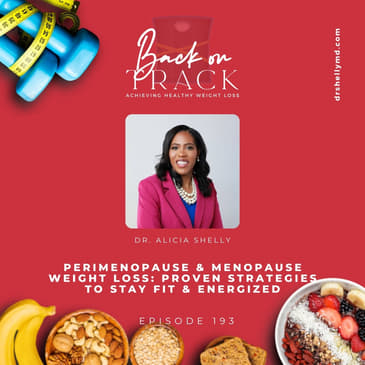
Weight loss during menopause isn’t impossible, it just requires a new approach.
In this episode, I discuss the challenges of weight gain during perimenopause and menopause, explaining how hormonal shifts impact metabolism, muscle mass, and fat distribution. I highlight why traditional diets may no longer be effective and emphasize the importance of balanced nutrition, including protein, fiber, and healthy fats. I also cover the benefits of strength training, cardio, and daily movement to maintain metabolism and overall health. Additionally, I share lifestyle tips such as stress management, quality sleep, and intermittent fasting. Most importantly, I encourage patience and self-compassion, reminding listeners that adjusting to these changes is a new chapter, not the end of their health journey.
Tune in now to learn how to take control of your weight and health during perimenopause and menopause!
Episode Highlights:
-
How hormonal changes impact weight gain during menopause
-
Why traditional diets may not work after 40
-
The role of protein, fiber, and healthy fats in weight management
-
Best exercises to boost metabolism and maintain muscle mass
-
Lifestyle habits to reduce stress, improve sleep, and support weight loss
Connect with Dr. Alicia Shelly:
-
Website | drshellymd.com
-
Facebook | www.facebook.com/drshellymd
-
Instagram | @drshellymd
-
Linked In | www.linkedin.com/in/drshellymd
-
Twitter | @drshellymd
About Dr. Alicia Shelly
Dr. Alicia Shelly was raised in Atlanta, GA. She received her Doctorate of Medicine from Case Western Reserve University School of Medicine in Cleveland, OH. Dr. Shelly has been practicing Primary Care and Obesity medicine since 2014. In 2017, she became a Diplomat of the American Board of Obesity Medicine. She is the lead physician at the Wellstar Medical Center Douglasville. She started a weekly podcast & Youtube channel entitled Back on Track: Achieving Healthy Weight loss, where she discusses how to get on track and stay on track with your weight loss journey. She has spoken for numerous local and national organizations, including the Obesity Medicine Association, and the Georgia Chapter of the American Society of Metabolic and Bariatric Surgeons. She has been featured on CNN, Fox 5 News, Bruce St. James Radio show, Upscale magazine, and Shape.com. She was named an honoree of the 2021 Atlanta Business Chronicle's 40 under 40 award. She also is a collaborating author for the, “Made for More: Physician Entrepreneurs who Live Life and Practice Medicine on their own terms''.
Resources:
FREE! Discover the 5 Reasons Your Weight-Loss Journey Has Gotten Derailed (And How To Get Back On Track!) 👉 Click
[00:00:00] Welcome back to the Back on Track Achieving Healthy Weight Loss, where I help you get on track and stay on track with your weight loss journey. I'm your host, Dr. Alicia Shelly. So let's get started.
[00:00:27] Welcome to the Back on Track Achieving Healthy Weight Loss podcast. I'm your host, Dr. Alicia Shelly. If you're in your 40s or 50s and struggling with unexplained weight gain, stubborn belly fat, or just shifts in energy level, you are not alone. Hormonal changes during perimenopause and menopause can make it harder to lose weight. But with the right strategies, you can manage your metabolism and feel your best.
[00:00:54] I mean, I see lots of patients and many of these women that come to me, they are so frustrated. The fact that what they used to do to lose weight is no longer effective. And since we are at the end of Women's Health Month, it's important to discuss the perimenopause and menopause and what practical strategies that you can use to help feel your best during the transition. So what happens during perimenopause and menopause?
[00:01:21] Well, perimenopause starts in the late 30s or 40s and can last for several years before menopause happens. During this time, some women who have a regular cycle can start to skip cycles, skip months. And then before you know it, you're considered in menopause when you've had 12 consecutive months without a period. And this average age could be around 51. Many women have different symptoms like hot flashes, night sweats.
[00:01:48] They can maybe have some brain fog, low energy, difficulty sleeping. So all of these symptoms can play a role during these stages. And you can have these symptoms even in perimenopause before you start to, even though you're having your cycles every month. And what happens hormonally is that your estrogen and progesterone levels fluctuate during perimenopause. And then after menopause, your estrogen and progesterone levels remain low.
[00:02:15] So let's chat about how does hormones impact metabolism and weight gain? So as estrogen starts to decline, it can be linked to increased belly fat and reduced muscle fat. So it's very common to look at your stomach and be like, why do I have all this weight or extra belly fat in my stomach? And then nothing I do is making it go away. Also, as progesterone starts to decline, it can cause water retention, bloating and mood swings.
[00:02:45] And those are some of the symptoms that people complain of, especially during perimenopause, the mood swings, where they can go from zero to 100 just like that. Your testosterone levels start to decrease, even though we don't have much in general, but they are decreasing. And that leads to more muscle mass and slower metabolism. So definitely we see women as they get older, that loss of muscle mass, which can make it weaker for them. And they're more at risk for falls.
[00:03:10] Also, you can see insulin resistance as you go through that perimenopausal state, which makes it easier to gain weight, especially around the abdomen area. And then cortisol can increase due to stress, which leads to fat storage around the midsection. So what are some signs of hormonal weight gain? Well, weight starts to accumulate around the midsection rather than the hips and thighs. And so usually the hips and thighs are important for childbirth, which is why the weight is accumulating in that area.
[00:03:39] But then after you hit menopause, you're not going to have a baby. So therefore the weight starts to accumulate around the midsection. Also, you start to have increased cravings for sugar and carbohydrates and this unexplained fatigue and difficulty sleeping. It's common for women to say that they were doing OK, but once they hit their perimenopause was hard for them to sleep or to stay asleep. You know, they wake up multiple times throughout the night. So why do traditional diets not work during menopause?
[00:04:06] Well, usually what people were doing, especially when they're younger, is they were doing extreme calorie restriction where they'd be so strict with their diet to lose weight. But what studies have shown is that when you have extreme calorie restriction, when you're eating like 500 to 600 calories a day, it can actually slow your metabolism down.
[00:04:27] Now, I don't know if any of you all are familiar with this TV show that came out in the early 200s called The Biggest Loser, where they had people get on TV and they would restrict their calorie diet. They were exercising so much to lose weight. And each week, the person who lost the next weight would win and the person who lost less weight would get banished from the ranch. It was very successful. It went from 2004 to 2016. So very successful show.
[00:04:53] But afterwards, they looked at the metabolism of the contestants. And what they noted is that even after they regained some of that weight back, their metabolism slowed down. So as they were losing weight, their metabolism decreased. And when they started to regain the weight back, their metabolism was still lower. And so what it shows is that as you try to lose weight, as you are restricting your calories, sometimes that can slow down your metabolism.
[00:05:18] And then also what studies have shown is that when you are trying to lose weight, sometimes your body kind of works against you. The hunger cues increase and the fullness cues decrease. So it makes it somewhat difficult. The reason being is that the body wants to survive. And so it wants to hold on to the weight instead of losing it. And so when you're trying to lose weight, your body will adapt in that direction. So let's look at what are some nutritional strategies that we can use to help with losing weight. Because you don't want to be on like an extreme calorie restriction diet.
[00:05:48] And so one of the things we need to prioritize is our protein. By having more protein in our diet, it can help maintain lean muscle mass and keep you full longer. So some examples of protein are like eggs, lean meats, tofu, Greek yogurt, legumes, extra things that you can incorporate into your diet to help with having the protein staying full longer with the extra protein. Also, it's important to increase your fiber intake. This helps with digestion, blood sugar control, and feeling more full.
[00:06:18] Some examples of fiber intake is going to be your leafy greens, berries, flax seeds, chia seeds, whole grains. These foods can help you with first of all having extra fiber, staying more regular. But then it can also help with blood sugar control and satiety. Also, it's going to be important to balance your carbs and fats. Aim for more complex carbs and healthy fats for a steady energy versus your simple sugars, simple carbs, especially like your cookies and candies. That makes a big difference.
[00:06:47] So some examples of good carbs are going to be your quinoa, sweet potato, beans. They're still carbs, but they're more healthy for you because they're complex and it takes longer for the body to digest them. Also, some healthy fats that you can consider are avocados, olive oil, nuts and seeds. And that too can help. It's also important to make sure you stay hydrated and drinking lots of water. This helps with supporting your metabolism, reducing your bloating and helping with cravings. Also limiting processed foods and sugar.
[00:07:16] This helps reduce inflammation and insulin resistance. So some better meal plans or approaches to consider for menopause are going to be your Mediterranean diet because it helps with anti-inflammatory. It's hormonal friendly and supports heart health for sure. Also intermittent fasting is helpful because it can help regulate your insulin and support fat loss. Also some portion control and mindful eating is important. So learn to recognize those true hunger cues versus emotional eating, which we all do.
[00:07:46] Now let's switch to look at activity or physical activity and how that is important during menopause. Now, while you exercising, it helps to counteract muscle loss and boost metabolism. It helps reduce stress and improves mood by increasing those endorphins. So you feel better once you exercise. Also, it helps to support your bone health and reduce the risk of osteoporosis. Because as you hit menopause, you start to lose that calcium.
[00:08:13] And so that puts you at more risk for osteoporosis. Now, the best types of exercise to include are going to be your strength training at least two to three times a week, which helps with building muscles, preventing AIDS related metabolic slowdown. Also, you can do strength training like bodyweight exercises like squats, lunges, pushups. These are also considered strength training. Resistance bands or weights for can also help as well as far as with those strength training.
[00:08:40] I always recommend you can go onto YouTube and just search strength training for where you are for beginners. And they get started and they can use different things around your house or the resistance bands or even just your body weight to help with strength training. Now, it is important to have cardio workouts as well. And then we recommend that three to four times per week. This helps with heart health and fat burning. And so you can do low impact cardio workouts like walking, swimming, cycling. But you can do high intensity interval training or HIIT.
[00:09:08] That is, it will get your heart rate up, but just in different segments. And then you have a minute to recover and then you go back into it. So that's why they call it high intensity interval training. Also, don't forget your yoga, Pilates, Tai Chi. These type of movements help with supporting flexibility, balance and stress reduction. Then, of course, you have your daily movement or what we describe as NEAT, non-exercise activity thermogenesis. And this is walking to meetings, taking the stairs, having a standing desk.
[00:09:37] So other lifestyle habits that you can start to do is number one, managing your stress and cortisol levels. That chronic stress can lead to increased belly fat. And so by deep breathing, meditation, hobbies or even social connections can help with reduction of the stress and cortisol level. Also, it's important to prioritize your sleep. Poor sleep disrupts metabolism and increases your cravings.
[00:10:01] You know, make sure you have a wind down routine, dimming the lights, reducing screens before bedtime, eating foods that are magnesium rich that can help you be able to sleep throughout the night. Also, like I mentioned before, intermittent fasting can be helpful. And you can do that 16-8 where you're fasting for 16 hours and eating for eight hours if that works best for you. And then, of course, consider medical support. If you're having really bad hot flashes and night sweats and it's just not getting better,
[00:10:30] just talk to your doctor about if it would be right for you to have hormone replacement therapy, where you can try supplements like omega-3, vitamin D, magnesium. But make sure you discuss with your health care provider what's best for you. So, in conclusion, weight loss during menopause and perimenopause is possible with the right approach. Make sure you're focusing on your nutrition, strength training, stress management and sleep. And most important, be patient and kind to yourself. Hormonal shifts require adjustments, not defeat.
[00:11:00] So, in conclusion, this is a new chapter. Remember, this is a new chapter at the end, not the end of your health journey. So, embrace the changes and make adjustments that work for you. I realize that sometimes what you did in the past didn't work. That's okay. Now you have another opportunity to try something different for where you are now. Well, thank you so much for joining us on the Back on Track Achieving Healthy Weight Loss podcast. If you like this episode, please share it with others. And don't forget to subscribe and leave a five-star review.
[00:11:29] Have a fabulous day. Let's be R-ечant. Do not forget FYI… Thank you. And I hope enough Shoulders, she know beyond this situation. Tell me that this is why. Thank you.