
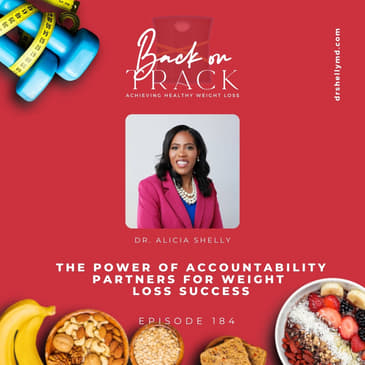
Accountability isn’t just support—it’s the catalyst that turns intentions into lasting results.
In this episode, I explore how accountability can be the secret ingredient to weight loss success, emphasizing the importance of support through accountability partners like friends, family, professionals, groups, or digital tools. Studies show that having an accountability partner can increase goal completion rates from 65% to 95%. I discuss various forms of accountability, from personal trainers and group activities to apps, and how they help maintain motivation, provide constructive feedback, and overcome setbacks.
I also share tips on finding reliable partners and being a supportive one, encouraging listeners to step out of their comfort zones to explore new options. Additionally, I highlight the importance of community advocacy for expanding access to obesity treatments through Medicare and Medicaid coverage.
Learn practical tips to find or become an accountability partner and take your health journey to the next level. Tune in now and start building the support system you need to achieve your goals!
Episode Highlights:
-
About accountability
-
Types of accountability partner
-
The benefits of accountability partners
-
Finding an accountability partner
-
Digital platforms and being a good partner
Connect with Dr. Alicia Shelly:
-
Website | drshellymd.com
-
Facebook | www.facebook.com/drshellymd
-
Instagram | @drshellymd
-
Linked In | www.linkedin.com/in/drshellymd
-
Twitter | @drshellymd
About Dr. Alicia Shelly
Dr. Alicia Shelly was raised in Atlanta, GA. She received her Doctorate of Medicine from Case Western Reserve University School of Medicine in Cleveland, OH. Dr. Shelly has been practicing Primary Care and Obesity medicine since 2014. In 2017, she became a Diplomat of the American Board of Obesity Medicine. She is the lead physician at the Wellstar Medical Center Douglasville. She started a weekly podcast & Youtube channel entitled Back on Track: Achieving Healthy Weight loss, where she discusses how to get on track and stay on track with your weight loss journey. She has spoken for numerous local and national organizations, including the Obesity Medicine Association, and the Georgia Chapter of the American Society of Metabolic and Bariatric Surgeons. She has been featured on CNN, Fox 5 News, Bruce St. James Radio show, Upscale magazine, and Shape.com. She was named an honoree of the 2021 Atlanta Business Chronicle's 40 under 40 award. She also is a collaborating author for the, “Made for More: Physician Entrepreneurs who Live Life and Practice Medicine on their own terms''.
Resources:
FREE! Discover the 5 Reasons Your Weight-Loss Journey Has Gotten Derailed (And How To Get Back On Track!) 👉 Click
[00:00:00] Welcome back to the Back on Track Achieving Healthy Weight Loss, where I help you get on track and stay on track with your weight loss journey. I'm your host, Dr. Alicia Shelly. So let's get started.
[00:00:28] And welcome to the Back on Track Achieving Healthy Weight Loss podcast. I'm your host, Dr. Alicia Shelly. Now, accountability is the secret ingredient to weight loss success. Because when you have support, you have unstoppable momentum. Today, we are going to dive into how establishing these accountability partners will help you stay on track and reach your goals.
[00:00:54] I would not necessarily say faster, but definitely being more consistent. So you may be thinking, how is this a secret ingredient to weight loss? Well, let me explain. When it comes to making our New Year's resolution, only about 9% of Americans feel that they are successful in keeping their resolutions throughout the year.
[00:01:16] One of the reasons that people stop keeping their resolutions is because they don't have support. And when they are having some difficulties or challenges, they don't have that support to help them move through them. And they get less motivation.
[00:01:30] The motivation leaves. According to a study by the American Society of Training and Development or ASTD, having an accountability partner can increase your chances of completing a goal from 65% to 95%.
[00:01:46] That's a huge margin. And the fact of being successful in that particular goal is higher as well. So when we think about accountability, it matters. Definitely in both personal and professional goals.
[00:02:04] Now let's define what exactly an accountability partner is. Now, an accountability partner is someone or something who supports another person to keep a commitment or maintain progress on a desired goal. Like I said, you can use this not only in your personal weight loss journey, you can use this at work, you can use this in writing, dissertation, whatever it is that you're trying to achieve, you can have an accountability partner.
[00:02:29] But for our purposes, we'll focus on what can we do for our health journey. Now, there are many types of accountability partner. When we think of accountability partner, we think of that one-on-one person that can either be a friend, a colleague, a family member who is helping us along, like who we can check in with and, you know, share our struggles, share our frustrations, or even share our wins.
[00:02:55] But it's usually somebody you know. But it can also be somebody who you hire. You can hire a personal trainer, you can hire a dietitian, a physiologist, somebody who is in the field who can help meet up with you. A personal trainer will meet up with you to go to a workout. A dietitian can meet up with you to kind of go through what you're eating to make sure you're eating more healthier. And it doesn't have to be every week. It can be once a month. Every month, you set the cadence per set.
[00:03:23] And then also, not to mention, maybe having your own primary care doctor or obesity specialist who you're meeting up with either on a monthly or quarterly basis to kind of check in to see where you are as far as in your weight journey or any obstacles and things that you may be facing.
[00:03:40] Another type of accountability partner is like a small group or team. I have friends who will stay active by going to their local kickboxing group where they meet twice a week and they're kickboxing, they're exercising for that one hour. Even though they're ready to play a game, it's something to keep them active and engaged. Personally, when I was trying to train for a triathlon, I would meet up with a group of people to go swimming.
[00:04:06] I didn't particularly care for swimming. So it was easier for me to go and swim with other people than it was for me to swim on my own. And so having that accountability where I know you're going to be here at this particular time and I'm going to show up makes a difference. I have other patients that go to the senior center and they have different classes there. So they'll meet up with their friends and do the classes or the water aerobics classes.
[00:04:30] It makes a difference having that accountability where you know this class is meeting this time and you're going to show up and do it. Another type of accountability partner can be a small group or not small groups, but apps or digital tools. We think of accountability as a person, but it doesn't have to be an actual person. It can be an app that is tracking what you're eating or what you're moving, how you're moving.
[00:04:52] It can be the little ring on your finger or a little Apple watch or a Fitbit or something like that that can help with moving along and kind of making you aware of what you're doing. Research shows that individuals who share their goals with a supportive partner or a group or even a tracking device are 65% more likely to achieve them. So it is important to kind of have these different accountability partners.
[00:05:19] And when you do have an accountability partner, it can help you in many ways, such as keeping you motivated, providing external perspective or constructive feedback, can help overcome procrastination or self-doubt, give you encouragement during setbacks, sharing ideas and strategies, and celebrating wins together to reinforce the positive behavior. So it can help you in more than just one way.
[00:05:45] A good example is that I was talking to a friend and she was sharing with me that around Thanksgiving, she was having a bad day at work. And the next day was Thanksgiving. I usually do the Thanksgiving half marathon and she usually does the 5K and she did 5K. She doesn't really feel like going to the 5K, but she knew that I was going to be there. So she's like, she didn't want to let me down. So she actually did get up Thanksgiving morning and do the 5K. But has she not had that accountability, she may not have done anything.
[00:06:13] So it definitely makes a difference. Having that accountability and knowing that people will be there, that makes it easier for you to want to continue that activity. I've had clients and patients who have started using trackers to track what they're eating. And they said to me that it did help them with not only reducing their portions, but eliminating like sugary beverages and foods that they weren't really aware of that they were eating. And when they saw themselves eliminating those particular foods, they felt better, they had more energy.
[00:06:43] And of course, they're exercising and losing weight. Now, the question is, how can I find an accountability partner? Well, there are many places where you can look. It can be more of your family, your friends, finding people who have similar goals to you, who are trying to lose weight. You can go on online community forums or social media groups. But be careful with the social media groups because sometimes you may share too many personal details.
[00:07:10] And sometimes you never know who's on there, who's looking, and it can affect you. It could get back to you, shall we say. But it's important to kind of maybe share your goals but not be as personal with the social media groups. But also you can have local meetups. Just like my friend who does the kickball classes or team, it helps her stay accountable. And that's what we're looking for. So what are the qualities you should be looking in an accountability partner, especially if you are looking for somebody to help you stay on track?
[00:07:40] Well, definitely you want to need somebody who's reliable. Somebody who not only has the same goals as you but are honest. And if you share something with them in confidence, they're not spreading it around to everyone else. Somebody who has that mutual commitment to success, that they're trying to do something for themselves as well. You want to have somebody who is offering encouragement without judgment. I know sometimes people use their spouses for their accountability partner, but they can be a little judgmental. And so that can be a little frustrating.
[00:08:08] So focusing on somebody who gives you encouragement without judgment and somebody or like an app that kind of works with you, that kind of gives you the feedback that you need and that's user-friendly, I would say, with the different apps. And sometimes it can be a little scary to ask somebody, hey, can you be my accountability partner? And that's okay because you never know what people are going to say. They could say no. They could be like, oh, I'm not the best. But it's okay.
[00:08:32] I would say if you're having these concerns, make sure you just kind of step out outside your comfort zone and try and have people and ask people to be your accountability partner and be upfront with them. And when you ask them, just say, hey, listen, you don't have to say yes, but would you mind being my accountability partner? This is what I'm trying to do.
[00:08:52] Also, finding different digital platforms or apps or websites designed for accountability, like my Fitness Pal, my Net Diary, our Habit Share, different things that are designed to help you stay accountable. And sometimes the best way to find an accountability partner is to be an accountability partner. And so to be a great accountability partner, it's important to support your partner. Make sure before you guys get started that you all know what the regular check-ins are, what the goals are.
[00:09:21] Make sure that you provide constructive feedback and positive reinforcement. Like don't like if they had a bad day, don't like get down on them. You know, just give them the feedback that they need. Also, define the frequency of communication on how when you guys want to talk. Is it through text messages, through calling? You decide what works best for you guys. And then agree on how you guys want to handle setbacks or missed goals. How can you support that person is the best thing.
[00:09:49] But then balance that support with achieving your own goals too. So in conclusion, studies have shown that by having an accountability partner, it could help you be more successful in your weight loss journey. And there are many different types of accountability partner. One-on-one, small group, digital apps. You can find it anywhere. And you can find them either in your family, your friends, colleagues who share similar goals. Or it could be online communities, forums, social media groups, or even just local classes.
[00:10:19] It could be your trainer, your obesity medicine doctor, your primary care. You decide what kind of works best for you and what you have. But remember, this may be a new journey for you. But just get out your comfort zone. Try something different. Try something new. You never know what you may find. And most importantly, you may find that it's actually that secret ingredient to your weight loss success. And so thank you again for being a part of the Back on Track family.
[00:10:48] And I hope that if you could, feel free to share this episode with somebody who needs to hear it. And don't forget to leave a five-star review. Also, I do want to make you aware that the Centers of Medicare and Medicaid are having an open forum where they want the public to share why the treatment of obesity is important. And so they want to hear your personal stories. They want to hear just your thoughts and comments. The 60-day comment session is ending on January 27th.
[00:11:18] So if you have a family friend or if you want to share your, you don't have to share your personal story, but you can share why it's important to you that they cover it. You may be thinking, well, I don't have Medicare. I don't have Medicaid. You don't have to. Because as the Medicare and Medicaid start to cover, a majority of the commercial insurances will start to cover.
[00:11:37] So if your commercial insurance does not cover weight loss medications, then it would be good to maybe give your comments so that maybe down the line, maybe one, two years from now, your insurance may start to cover it as something that should be covered automatically instead of something that you have to opt into. I will leave that information on different links in the show notes. So feel free to look at that.
[00:12:01] And I hope that you're able to share your comments because the more qualitative comments that we have, they're going to read all of us. CMS is going to read all of our comments, but it may help them with their decision on whether to cover weight loss medications or not. All right. I look forward to seeing you all next time. Have a great rest of your week.