
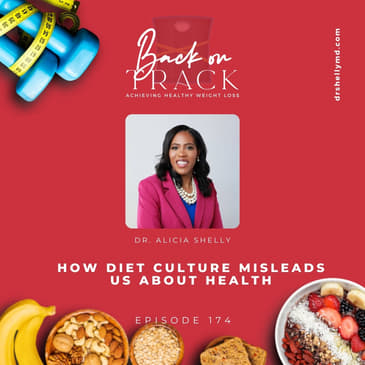
Is diet culture helping or hurting us?
Earlier in my journey, I didn’t question what diet culture was—I simply accepted its ideas as fact. From counting calories to trying extreme diets, I thought all these efforts were necessary for my health and happiness. But as I dug deeper into obesity medicine, I learned how diet culture leads us to label foods as "good" or "bad," drives unhealthy weight-loss behaviors, and can cause us to overlook more important health indicators, like our energy and mental well-being. In this episode, I share personal stories about breaking free from these harmful beliefs and discovering a healthier, more compassionate approach to wellness.
Tune in now for a fresh, empowering take on building a positive relationship with food, fitness, and body image.
Episode Highlights:
-
The roots and influences of diet culture on our beliefs about food and body image.
-
Personal stories and the lifelong effects of restrictive dieting.
-
The complex factors affecting weight beyond just diet and exercise.
-
How diet culture contributes to weight stigma and body dissatisfaction.
-
Practical tips on moving toward a balanced, intuitive approach to eating.
Connect with Dr. Alicia Shelly:
-
Website | drshellymd.com
-
Facebook | www.facebook.com/drshellymd
-
Instagram | @drshellymd
-
Linked In | www.linkedin.com/in/drshellymd
-
Twitter | @drshellymd
About Dr. Alicia Shelly
Dr. Alicia Shelly was raised in Atlanta, GA. She received her Doctorate of Medicine from Case Western Reserve University School of Medicine in Cleveland, OH. Dr. Shelly has been practicing Primary Care and Obesity medicine since 2014. In 2017, she became a Diplomat of the American Board of Obesity Medicine. She is the lead physician at the Wellstar Medical Center Douglasville. She started a weekly podcast & Youtube channel entitled Back on Track: Achieving Healthy Weight loss, where she discusses how to get on track and stay on track with your weight loss journey. She has spoken for numerous local and national organizations, including the Obesity Medicine Association, and the Georgia Chapter of the American Society of Metabolic and Bariatric Surgeons. She has been featured on CNN, Fox 5 News, Bruce St. James Radio show, Upscale magazine, and Shape.com. She was named an honoree of the 2021 Atlanta Business Chronicle's 40 under 40 award. She also is a collaborating author for the, “Made for More: Physician Entrepreneurs who Live Life and Practice Medicine on their own terms''.
Resources:
FREE! Discover the 5 Reasons Your Weight-Loss Journey Has Gotten Derailed (And How To Get Back On Track!) 👉 Click
[00:00:00] Welcome back to the Back on Track Achieving Healthy Weight Loss, where I help you get on track and stay on track with your weight loss journey. I'm your host, Dr. Alicia Shelly. So let's get started.
[00:00:28] Welcome to the Back on Track Achieving Healthy Weight Loss podcast. I'm your host, Dr. Alicia Shelly.
[00:00:34] Now, earlier this week, I was doing a talk about diet culture and how it can contribute to weight stigma. And this was my first time kind of exploring what diet culture was.
[00:00:47] And I didn't realize till I was preparing for this talk that I had been engaging in diet culture, especially in my 20s. And I didn't realize that at the time.
[00:00:59] Growing up, I was told that if you eat less and move more, you'll lose weight. And that's what I thought.
[00:01:06] So when I was in college, I actually struggled with my weight all my life, even as a child and teenager and everything.
[00:01:14] So when I was in college, though, I was able to start to lose weight when I moved off campus, started cooking for myself, eating better.
[00:01:22] And then I had taken this water aerobics class. And so just with that eating less, moving more, I started to lose weight.
[00:01:29] Now, I could not tell you what my weight was at the time, but I noticed that I could get into smaller sizes.
[00:01:36] And by the time I hit graduation, you couldn't tell me nothing. I just knew I was hot stuff.
[00:01:43] But then the year after graduation, I'd taken that off and was studying abroad and my weight came back.
[00:01:51] I remember starting while I was away doing this whole lemonade diet so I could lose weight.
[00:01:57] And I think I lost like maybe five pounds, but I thought I was going to die by the end of the five days.
[00:02:03] Like I thought death was coming to me. But when I got back, I was like, man, I'm really trying to get healthy again.
[00:02:09] So I did all types of diets, low carb, plant based calorie restriction, Weight Watchers, Jenny Craig.
[00:02:17] I mean, I had a whole little book that I would write down what I would do, what I would eat, how I would exercise.
[00:02:25] And I wanted to make sure that there was net negative 500 calories so that at the end of the week, it would be a negative 3,500 calories, which would equal up to one pound.
[00:02:36] Like that's what I was taught.
[00:02:37] But what I didn't realize is that when I would stop doing these interventions, when stress would come up or I was in med school, so that was very stressful.
[00:02:47] So always something was coming up and I get off track, my weight would come back.
[00:02:52] And it wasn't until I started studying about obesity medicine when I learned that number one, obesity is a chronic disease and that there are multiple reasons why people gain weight.
[00:03:04] And those reasons can be endocrine, like whether you have a thyroid issue, PCOS.
[00:03:10] It can be genetics, which that's what I have.
[00:03:13] Like in my family, we tend to have extra weight.
[00:03:16] It can be psychological, depression, anxiety that can play a role, environmental, immune.
[00:03:23] Like there's so many different factors that play a role in allowing people to gain weight and then having difficulties with losing it.
[00:03:31] And that just blew my mind because before I thought weight loss was math.
[00:03:36] Two plus two equaled four.
[00:03:38] But in actuality, obesity is a chronic disease and math has no place here.
[00:03:45] Two plus two does not equal four when it comes to obesity.
[00:03:49] And what I learned was that we all have like a certain set point or certain weight that our body likes to be.
[00:03:57] And when we lose weight, our body actually works against us.
[00:04:02] It actually does something that we describe as metabolically adapts, where basically it will decrease your hunger hormones.
[00:04:10] Well, when you lose weight, it will increase your hunger hormone so that you would eat more.
[00:04:15] And then also it will reduce your metabolism so that you burn less calories so that you will be able to keep the weight to come back to that set point.
[00:04:25] And if you gain weight, it does the opposite.
[00:04:27] It decreases your hunger hormone and then it also increases your metabolism so that you can gain weight and get back to that set point.
[00:04:35] And so a lot of times when we are losing weight, that set point sometimes changes or sometimes not, but it actually our body adapts.
[00:04:44] And so it's very common for us to get hungry again after we've lost a certain amount of weight or get to that plateau.
[00:04:50] And then we have to change other stuff to kind of keep moving forward.
[00:04:54] And I think I'll probably talk about this in more detail at a later date.
[00:04:57] But needless to say, the fact that this set point theory, the fact that obesity is a chronic disease was not something that I knew about in my early young adult age, in my early 20s.
[00:05:09] And because of that, I was going based on what I thought was right, but it wasn't.
[00:05:15] And it made so much sense that when I stopped doing those different diets, doing those interventions, that my weight came back.
[00:05:23] And so I wanted to kind of delve in today about what is diet culture and how are we actually seeing?
[00:05:30] Because I was very surprised about what it is and basically how it affected my life.
[00:05:36] So let's just go to the definition.
[00:05:38] So diet culture is a set of myths and expectations around food and weight, which typically equates to thinness, to health, and categories of foods into good or bad types.
[00:05:50] Now, some examples, common examples of diet culture is like number one, good versus bad foods.
[00:05:56] We label foods as good or bad based on their calorie content or perceived healthiness.
[00:06:03] Like a good example is salad, good.
[00:06:06] Bread, bad.
[00:06:08] But is bread really bad for you?
[00:06:10] Are carbs really bad?
[00:06:11] I've had several people tell me, well, you know, carbs are bad, right?
[00:06:14] And I'm like, no, you actually do need carbs for hormone production.
[00:06:18] Like they do have a purpose.
[00:06:19] But in our minds, we label these foods as good or bad.
[00:06:23] And let's say if I eat a roll, sometimes we create guilt or shame around eating that because in our mind is good or bad.
[00:06:31] Another example of diet culture is the ideal body.
[00:06:36] Promoting that thinness or certain body type is the only ideal body that we should attain to or often and then have.
[00:06:45] And we disregard the natural diversity in all bodies, shapes and sizes.
[00:06:50] I remember watching one of these reality TV shows where, you know, you have groups of women and sometimes they can be very catty.
[00:06:58] And in this particular TV show, the women were at a gala and a woman came up.
[00:07:04] She was talking from the stage and she was saying she was a woman living with obesity.
[00:07:08] And she was speaking about why it's important that we love and value ourselves regardless of your body.
[00:07:15] So she was combating diet culture, basically.
[00:07:18] And we'll talk about that value.
[00:07:20] But she said we should value ourselves regardless of where we are in our journey.
[00:07:24] And I was so ashamed that one of the women who was also a doctor in this group went up to this woman after she spoke, once everybody was gone,
[00:07:35] and proceeded to tell her how unhealthy she was because she was living with obesity.
[00:07:39] And at the time, it just really burned me.
[00:07:43] I was just like, I can't believe she had the gall to tell this lady that she was unhealthy.
[00:07:47] She doesn't know what her cholesterol is.
[00:07:50] She doesn't know what her A1C or diabetes number is.
[00:07:55] This lady could be healthier than she is.
[00:07:58] Because in that, the woman's mind from the TV show, she was basically promoting that ideal body that if you weren't thin, you weren't healthy.
[00:08:06] But there is such a thing as being fat thin.
[00:08:11] Meaning there are people who are thin, but they have a lot of visceral fat.
[00:08:16] Meaning fat that surrounds the heart.
[00:08:18] Fat that surrounds the blood vessels.
[00:08:21] Fat that surrounds the liver.
[00:08:22] And it puts people at increased risk for stroke, heart attacks, diabetes, fatty liver, or NASH as we like to call it.
[00:08:31] Or NASH, they keep changing the name.
[00:08:33] But non-steotelic, fatty liver.
[00:08:36] And it puts people at that risk.
[00:08:38] And there are people who are living with obesity, but they don't have that.
[00:08:43] It's just more of a visceral fat where the fat's maybe under the skin versus around the organs.
[00:08:49] And the risk for heart disease is a lot different between those two individuals.
[00:08:54] And so this lady, who was a doctor, went up and was promoting this whole ideal body.
[00:09:01] And she was on TV.
[00:09:03] Like there's thousands of people saw this particular episode.
[00:09:06] And it's just another reason why that diet culture gets in.
[00:09:10] And I will say as a doctor, I didn't learn about obesity being a chronic disease and the set point theory.
[00:09:16] So I started actually studying obesity medicine.
[00:09:18] This wasn't something we were taught in medical school.
[00:09:22] And so there's a lot of doctors who need some retraining.
[00:09:26] And this particular person on this TV show was one of them.
[00:09:29] So needless to say, that ideal body.
[00:09:32] Also, weight loss being as the primary health goal.
[00:09:36] So another example of diet culture is weight loss being a primary health goal.
[00:09:40] Emphasizing weight loss as the primary marker of health and success.
[00:09:44] Rather than focusing on other health indicators like mental well-being, energy levels, physical fitness.
[00:09:50] The reason why this is important is because there are people who literally starve themselves
[00:09:55] to lose weight.
[00:09:56] And when they lose weight, they lose muscle.
[00:09:59] Yes, they're losing fat.
[00:10:01] But it's not a very healthy weight.
[00:10:03] And in fact, some people lose so much weight unhealthy.
[00:10:08] Like if you have anorexia or bulimia, it can actually cause more medical problems.
[00:10:15] It could cause worsening of the bone, bone weakness, teeth coming out.
[00:10:20] It can act malnutrition because of the fact that people are starving themselves.
[00:10:25] I'm not saying you're starving themselves, but I just want us to look at this as a whole.
[00:10:28] That yes, weight loss is good and it can be healthy, but it's not the primary marker.
[00:10:34] So we need to focus on other health indicators.
[00:10:37] I have some people who may not lose as much weight as they'd like to when they come see me for that fall visit, but they have more energy.
[00:10:46] They can move better.
[00:10:47] They're walking without a cane.
[00:10:48] I saw another lady last week.
[00:10:51] Every time she would come to see me, she was my primary care patient.
[00:10:55] She was in a wheelchair, in a wheelchair.
[00:10:57] And this time she came to see me, she was walking.
[00:11:01] She didn't have a wheelchair.
[00:11:02] She didn't have a cane.
[00:11:03] She didn't have anything.
[00:11:04] And she only lost from what we saw, seven pounds.
[00:11:08] But she's like, doc, I feel so much better.
[00:11:11] I have so much energy.
[00:11:12] So sometimes, yes, losing weight is important, but it's not the only thing.
[00:11:17] And we need to focus on other markers like well-being, energy level, physical fitness, the other non-scale victories.
[00:11:25] Also, sometimes another example of diet culture is moralizing food choices.
[00:11:31] Phrases like, oh, I'm being good when I'm eating a salad or I'm being bad when I'm eating dessert.
[00:11:38] This implies that one's worth is tied to their food choices, which is not the case.
[00:11:43] I remember I went camping and there was a gentleman there.
[00:11:47] He was really fit and exercise and stuff like that.
[00:11:50] But we had already finished eating breakfast.
[00:11:52] All the food was put up.
[00:11:53] And he's like, oh, I forgot to take my medication.
[00:11:55] I see this cookie here.
[00:11:57] Don't judge me.
[00:11:58] I'm going to eat this cookie so that I can take my medication.
[00:12:00] And I'm thinking to myself, it's fine.
[00:12:02] You need something for your medication.
[00:12:05] There is no judgment here.
[00:12:06] Eat the cookie.
[00:12:07] I'm not going to go and tell your wife.
[00:12:10] There's nothing bad about this cookie.
[00:12:12] It's just that you needed it right now.
[00:12:14] And I don't say that to mean like you need to go and just binge on cookies.
[00:12:18] No.
[00:12:18] I mean, that's not what I'm saying.
[00:12:19] But I'm just trying to say that we shouldn't moralize the food choices.
[00:12:24] Also, restrictive eating programs.
[00:12:26] So there's a lot of popular diets that require strict rules.
[00:12:30] Like you can only eat this particular food.
[00:12:34] A good example of this may be the blood type diet where you can only eat certain foods in
[00:12:39] your blood type in order to lose weight.
[00:12:41] And so it's very restrictive in that manner.
[00:12:43] And there's other diets out there that are very, very strict calorie counting.
[00:12:48] They eliminate entire food groups, promoting that either you have to do this.
[00:12:53] Maybe they promote this all or nothing mindset.
[00:12:55] Either you do this to lose weight or nothing will work instead of having a balanced approach
[00:13:00] to eating.
[00:13:01] Also, there's such a thing.
[00:13:03] Another example of diet culture is thin privilege where there's societal benefits or preferences
[00:13:09] given to people with smaller bodies, such as being able to shop for clothes more easily,
[00:13:15] which is when I lived in San Francisco, literally I walked into Macy's and I was living with obesity.
[00:13:23] I had one rack, one rack for me, for my size.
[00:13:28] And if you were petite, not even you were regular, but if you were petite, they had a whole section
[00:13:34] of petite clothes because the majority of the people, there was such a large Asian population
[00:13:41] in San Francisco and a lot of these women were petite.
[00:13:44] So they had this large, petite section and I had one rack for myself.
[00:13:50] So I'm like, well, gosh darn it.
[00:13:52] If I didn't like the color, that's all I had to wear.
[00:13:54] If I was going to buy clothes from Macy's.
[00:13:57] So sometimes it's harder sometimes to find more clothes if you are living with obesity.
[00:14:03] Also fitting into standard seats comfortably is thin privilege.
[00:14:08] Because if you're on a plane, sometimes people can be very ugly, very ugly.
[00:14:13] I remember I was on standby and I got on this flight and I'm like, yes, I got on this flight.
[00:14:18] I'm going to get home.
[00:14:20] And I go to sit in the spot and the lady who is sitting by the window, she looks at me
[00:14:27] and she's like, can you find another seat?
[00:14:29] Is what she told me.
[00:14:31] Now, mind you, I'm on standby.
[00:14:33] And if you're on standby, you're just taking whatever seats open.
[00:14:35] And what was crazy to me that the lady who asked me to get into a different seat was also living with obesity.
[00:14:42] We're in the same boat, but she wanted to be comfortable.
[00:14:46] So she's like, go find another seat.
[00:14:48] And it was just so happened that one of the men, I was so super, super duper nice.
[00:14:52] He allowed me to sit with him, but it was just horrible, that thin privilege.
[00:14:57] And I recently heard a story.
[00:14:58] I was having dinner with a few friends.
[00:15:01] And one of my friends told me that she was on Southwest.
[00:15:04] And if you ever fly Southwest, they have first come first serve seating.
[00:15:09] So if you are like within the A group, you can sit anywhere in the flight.
[00:15:14] And so there was this lady, the stewardess was sitting in the middle seat at the exit row.
[00:15:20] And there was these two large men on the side.
[00:15:23] And she was just sitting there.
[00:15:25] And it wasn't until my friend came up that she got up and was like, hey, would you mind sitting there?
[00:15:30] The two men wanted somebody who was short to sit in between them.
[00:15:34] And I was thinking to myself, first of all, the exit row seat, I mean, yes, you do need to help people in the event.
[00:15:41] There is an emergency, so don't get me wrong.
[00:15:43] But usually it's for people who have long legs or who need the extra floor space.
[00:15:48] So the fact that they would just have the stewardess sit in the middle until somebody who they thought was thin or sitting in the standard seats would be better fitted.
[00:15:59] And then she got up.
[00:16:00] It's just horrendous to me.
[00:16:02] I was like, I can't believe this.
[00:16:04] So needless to say, there is such a thing as thin privilege.
[00:16:08] And then another example of diet culture is cheat days.
[00:16:13] So this concept that suggests that some foods are off limits or forbidden actually is very strict and that you can only eat it on your cheat day implies guilt or the need for strict control.
[00:16:25] So it's important to kind of reduce those cheat days and actually have more of a balance would be the goal.
[00:16:33] And also using fitness as punishment.
[00:16:36] I'm encouraging exercise primarily as a way to burn off calories rather than a way to improve physical or mental health.
[00:16:43] And then last but not least, associating thinness with happiness and confidence.
[00:16:48] I've seen many people and everybody's in different categories, but sometimes people feel like in order for me to be happy, I need to be this particular weight.
[00:16:58] And if I can't get to this weight, I won't be happy.
[00:17:00] And so that is one of the ideas that's promoted with diet culture.
[00:17:06] And it implies that you'll only be happy or confident or loved if you're thin or lose weight, which actually contributes to more of a negative self-image.
[00:17:15] So why is diet culture so harmful?
[00:17:19] And it's harmful because it promotes an unrealistic, often unhealthy expectation about body image, self-worth and health.
[00:17:27] And so a couple of reasons how it's harmful is that it promotes disordered eating.
[00:17:33] Diet culture encourages restrictive eating, yo-yo dieting, and obsession with calories and weight, which can lead to disordered eating behaviors and eating disorders like anorexia, bulimia or binge eating.
[00:17:46] It reduces your self-worth to physical appearance.
[00:17:49] It promotes the idea that one's value is tied to their body size or weight, which can lead to a poor self-esteem and body satisfaction, especially when people don't meet the society's narrow beauty standards.
[00:18:05] Also, it can increase the risk of mental health issues.
[00:18:09] It can lead to more guilt, more shame, anxiety around food choices and body image.
[00:18:15] Like you worry, you're going to a birthday party, you're like, oh my gosh, I don't want to eat the cake.
[00:18:19] The cake is bad.
[00:18:20] And so it's more anxiousness when you go.
[00:18:23] Also, it's like a lot of self-criticism and pressure, which can lead to more depression, anxiety, and mental health issues.
[00:18:30] And also ignores true health indicators.
[00:18:34] By equating health fitness with health, diet culture ignores more meaningful health indicators, such as a mental well-being, energy levels, strength, and fitness.
[00:18:45] And encourages people to prioritize weight over health, which can result in poor physical and mental outcomes.
[00:18:51] The other thing I would say, like I said earlier, that there is such a thing as being thin fat, where you are a thin person, but because of the extra adipose layers around the heart, around the liver, you're not very healthy and you have an increased risk for more cardiovascular disease.
[00:19:10] And so because in our mind, you're thinking, well, I'm thin, I'm healthy, I'm good, I'm good.
[00:19:14] You may not be able to seek that the proper preventative care that is necessary.
[00:19:21] Also, diet culture creates a cycle of guilt and shame.
[00:19:24] When people inevitably fail the restricted diets and engage in forbidden eating, they may feel more guilt, shame, or a sense of moral failure.
[00:19:34] This cycle can perpetuate unhealthy relationships with food and body image.
[00:19:39] And then it also excludes and marginalize people.
[00:19:43] Diet culture stigmatizes those in larger bodies, which can lead to discrimination, weight stigma, and exclusion.
[00:19:49] Just like I mentioned with that lady in that reality TV show.
[00:19:53] That doctor did not know her.
[00:19:55] She did not know what her cholesterol was, what her diabetes numbers was.
[00:20:01] She didn't know anything about this lady.
[00:20:03] All she saw that this lady had was living with obesity and that she had to be unhealthy.
[00:20:08] And so she was engaging in weight stigma because of her own negative stereotypes about people living with obesity.
[00:20:17] And you know what?
[00:20:18] Weight stigma can affect many people, especially with people living with obesity.
[00:20:23] And it can be anywhere.
[00:20:24] It can be at home.
[00:20:26] Your own family can utilize weight stigma.
[00:20:28] At work, people, they've done studies looking at weight stigma.
[00:20:32] And people tend to look down on people who have extra weight.
[00:20:37] Also at school, kids being bullied, it can affect a person's access to health care, social experiences, and even employment opportunities.
[00:20:46] Because people are being judged unfairly based on their weight.
[00:20:51] I look at myself, and I'm a woman living with obesity.
[00:20:54] And you would look at me and never guess that I have done seven marathons, two Ironman 70.3, and attempted two full iron.
[00:21:04] Like you would never look at me and guess that.
[00:21:07] But people may look at me and say, oh, she must be lazy.
[00:21:11] That is the exact opposite.
[00:21:13] And not that I do this stuff for other people.
[00:21:16] No, I do it for me because it's fun for me.
[00:21:18] I don't do it to burn calories.
[00:21:20] I do it because it's fun and I am an overachiever and I enjoy the challenge.
[00:21:25] But we have to be able to help people realize that they do have this stigma.
[00:21:30] They do have this body's weight bias.
[00:21:32] And that they should not judge people just based on their weight.
[00:21:36] The other reason why diet culture can be harmful is that it can damage physical health.
[00:21:42] Constant dieting and restriction can slow metabolism, weaken bones, reduce muscle mass, which is leading to poor long-term health outcomes.
[00:21:51] Additionally, extreme diets can increase the risk of heart problems, nutrient deficiencies, and other physical health issues.
[00:21:58] I'm not sure if you're aware, but back in, I guess this was the early 200s, 2000s.
[00:22:06] I can't remember exactly what year.
[00:22:08] But there was this show called The Biggest Loser.
[00:22:10] It was huge on NBC and it went for so many different seasons.
[00:22:14] And so it basically took a group of people living with obesity, all different sizes, men and women.
[00:22:20] And they made them decrease what they were eating.
[00:22:23] They exercise.
[00:22:23] Like they saw these people just walking, exercise, doing, exercising like throughout this thing.
[00:22:30] We were at like this retreat, shall we say, this obesity retreat where they would lose weight.
[00:22:35] And so they had to watch what they were eating and all these things.
[00:22:38] And then down the line after the show was over, they looked at the people who had lost weight on that show.
[00:22:45] And they actually checked their metabolism.
[00:22:49] And even the people who had lost weight and regained the weight back, they still had a slower metabolism than before when they started the show.
[00:23:00] Even if they regained all the weight back that they lost.
[00:23:03] And so it just shows us that with all this constant dying and restrictions, it can actually have long-term health outcomes as far as slow metabolism.
[00:23:13] And then also, especially because if you're like starving yourself and you're not eating properly, you're not getting the right nutrients.
[00:23:21] That can lead to weakened bones, reduced muscle mass, and then just other conditions.
[00:23:28] And the last thing we want you to do, and this is why we're always checking, is that we want to make sure that your muscle mass is when you're losing weight, that that's not going down.
[00:23:37] Because we want you to continue to keep your muscle mass.
[00:24:01] And then last but not least, it fails to address the whole person.
[00:24:08] Diet culture does not consider each person's unique needs, mental health, or cultural background.
[00:24:14] It offers a one-size-fits-all approach that can leave people feeling isolated, disconnected, and frustrated.
[00:24:21] And so by perpetuating these unrealistic and narrow definitions of health and beauty, diet culture can prevent people from living a balanced, fulfilling life, and undermining both mental and physical well-being.
[00:24:35] And so it's important that we shift away from diet culture so that we can build more healthier, more compassionate relationships with their bodies, food, and overall health.
[00:24:46] So how can we avoid this?
[00:24:50] Because like I said, it wasn't until I was really researching this topic that I realized that I'm sometimes playing into this role.
[00:24:57] And so here are a couple of tips that we can use to kind of avoid diet culture and overcome it.
[00:25:04] First thing, number one, practice intuitive eating.
[00:25:07] Listen to your body's hunger and fullness cues rather than following restrictive diet rules.
[00:25:13] Intuitive eating encourages you to eat when you're hungry and stop when you're full.
[00:25:16] And enjoy a variety of foods without feeling guilty, without having a cheat day where I'm going to just indulge in everything that I can't have.
[00:25:24] Yeah.
[00:25:25] You enjoy it, but do it without guilt.
[00:25:28] Focus on health and not weight.
[00:25:30] Instead of focusing on weight loss as the primary goal, prioritize habits that promote overall health, like staying active, getting enough sleep, managing stress, eating a balanced diet.
[00:25:41] Health isn't defined by the scale.
[00:25:44] And reject food labels.
[00:25:46] Avoid labeling foods as good or bad.
[00:25:49] And recognize that all foods can fit into healthy lifestyle.
[00:25:53] This mindset allows you to enjoy a balanced diet without guilt or moral judgment around what you eat.
[00:25:59] Limit your body comparisons.
[00:26:02] Avoid comparing your body to others or to unrealistic beauty standards promoted by the media.
[00:26:07] And focus on your own unique strengths and qualities and recognize that everyone's body is different.
[00:26:14] I do find with social media, there are many accounts that can push unrealistic body ideals, diet trends, and then make you feel insecure about yourself.
[00:26:24] And so if that's the case, I would unfollow those accounts and follow accounts of people that promote body positivity, self-acceptance, and a healthy relationship with food.
[00:26:34] Also, make sure to avoid restrictive diets that require strict rules and extreme calorie restriction and elimination of entire food groups.
[00:26:44] Instead, aim for a balanced and enjoyable approach to eating that includes a wide variety of foods.
[00:26:50] Reframe your exercise as self-care.
[00:26:54] Reframe it as exercise to feel good and enjoyable, not something that you do just to burn calories.
[00:27:00] Find activities that you love.
[00:27:02] And it may just be dancing, hiking, yoga.
[00:27:05] Think of movement as a way to boost energy and improve mood.
[00:27:09] Also, be mindful of the language that you use, especially around your body, food and body.
[00:27:16] Like calling yourself bad or calling yourself fat, especially bad for eating a treat or praising others for losing weight.
[00:27:25] Like just watch the language that you use and try to use language that has more kindness, understanding, and acceptance instead.
[00:27:31] Also, make sure you seek support when you need it.
[00:27:34] Building healthy relationships with food and body image can take time, especially if you've been like me.
[00:27:41] It's been years influenced by diet culture.
[00:27:44] And sometimes if you need a support from a therapist, dietitian, an obesity medical specialist that can help promote that positive approach to wellness.
[00:27:52] But last but not least, make sure to celebrate your non-scale victories.
[00:27:56] And the one thing I think I'm going to change in my own practice is making sure that the patients write down what those non-scale victories are.
[00:28:04] Because sometimes people are like, I just want to lose weight.
[00:28:06] I just want to lose weight.
[00:28:07] But there's more to it than losing weight, right?
[00:28:09] We're losing weight to do what?
[00:28:11] Is it to be more healthy?
[00:28:12] Because actually, like I said before, our weight does not dictate happiness.
[00:28:17] That's what diet culture wants us to believe.
[00:28:20] But if our goal is to be healthy, then we need to have those non-scale victories.
[00:28:24] So I think definitely that's something I'm going to be promoting more in my practice.
[00:28:28] Well, I know this is a lot.
[00:28:31] And like I said, even me, I didn't realize how important it is, how diet culture had influenced my thinking prior to doing this talk.
[00:28:41] And this may be a complete eye-opener for you as well.
[00:28:45] But my suggestion is take one or two things that you can do to help reframe your thoughts around it and try to kind of promote or avoid diet culture.
[00:28:55] And I thank you so much for your time.
[00:28:58] And I hope that as we continue to overcome the diet culture that we have been engrossed in, we can build a more healthier, more sustainable relationship with food, exercise, and our body and create a foundation where not only do we lose weight healthy, but we also have those non-scale victories as well.
[00:29:19] Focus on those non-scale victories as well.
[00:29:21] Thank you again for joining us on the Back on Track Achieving Healthy Weight Loss.
[00:29:25] If you like this episode, please share with others.
[00:29:28] Like it and subscribe.
[00:29:29] And don't forget to leave a five-star review.
[00:29:32] And we will see you next time.