
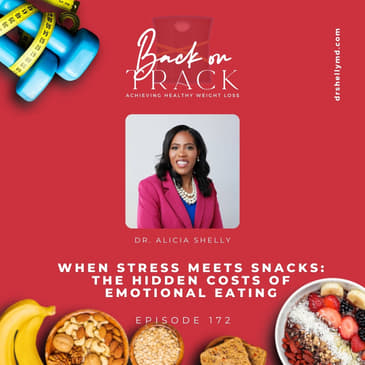
Turning to food for comfort is a common habit, but emotional eating often leaves us feeling emptier than before.
In this episode, I discuss emotional eating, where stress and other emotions drive us to food for comfort rather than actual hunger. Emotional eating is reinforced by biological responses like the release of cortisol and dopamine, creating a cycle of eating to soothe emotions. To manage this, I recommend recognizing the difference between emotional and physical hunger, checking in with yourself before eating, using stress-management techniques, and setting a regular eating routine. Seeking support can also help if emotional eating becomes a persistent issue. Remember, it’s okay to ask for help along the way.
Tune into this episode to learn practical strategies to break the cycle of emotional eating and take back control of your health!
Episode Highlights:
-
About emotional eating
-
Science behind emotional eating
-
Cycle of emotional eating
-
Recognizing the difference between emotional and physical hunger
Connect with Dr. Alicia Shelly:
-
Website | drshellymd.com
-
Facebook | www.facebook.com/drshellymd
-
Instagram | @drshellymd
-
Linked In | www.linkedin.com/in/drshellymd
-
Twitter | @drshellymd
About Dr. Alicia Shelly
Dr. Alicia Shelly was raised in Atlanta, GA. She received her Doctorate of Medicine from Case Western Reserve University School of Medicine in Cleveland, OH. Dr. Shelly has been practicing Primary Care and Obesity medicine since 2014. In 2017, she became a Diplomat of the American Board of Obesity Medicine. She is the lead physician at the Wellstar Medical Center Douglasville. She started a weekly podcast & Youtube channel entitled Back on Track: Achieving Healthy Weight loss, where she discusses how to get on track and stay on track with your weight loss journey. She has spoken for numerous local and national organizations, including the Obesity Medicine Association, and the Georgia Chapter of the American Society of Metabolic and Bariatric Surgeons. She has been featured on CNN, Fox 5 News, Bruce St. James Radio show, Upscale magazine, and Shape.com. She was named an honoree of the 2021 Atlanta Business Chronicle's 40 under 40 award. She also is a collaborating author for the, “Made for More: Physician Entrepreneurs who Live Life and Practice Medicine on their own terms''.
Resources:
FREE! Discover the 5 Reasons Your Weight-Loss Journey Has Gotten Derailed (And How To Get Back On Track!) 👉 Click
[00:00:00] Welcome back to the Back on Track Achieving Healthy Weight Loss, where I help you get on track and stay on track with your weight loss journey. I'm your host, Dr. Alicia Shelly. So let's get started.
[00:00:27] Welcome to the Back on Track Achieving Healthy Weight Loss podcast. I'm your host, Dr. Alicia Shelly.
[00:00:34] Have you ever felt stressed and found yourself standing in front of the refrigerator or the pantry searching for something to eat, even though you knew you weren't hungry? I know I've done that. And this is a classic example of emotional eating. Emotional eating is the act of turning to food in response to emotions, stress, or other feelings, rather than a physical hunger.
[00:01:02] This can also be known as comfort eating or stress-induced eating. And this behavior often leads to consuming foods that are high in calories, but low in nutrients and foods that offer a temporary relief, but can contribute to long-term health issues. Emotional eating is a way many of us try to cope with negative emotions like sadness, anxiety, and stress.
[00:01:28] Now, while some eating disorders have emotional eating as a characteristic, such as binge eating, in this episode, we will be focusing on the general emotional eating, just in general, or the umbrella terminology.
[00:01:46] And if you experience an eating disorder, such as binge eating, or any of the other different eating disorders, it is important that you seek professional help for that.
[00:01:59] Because today, we're just going to be focusing on general emotional eating.
[00:02:04] Now, according to a survey by the American Psychological Association, 38% of adults reported engaging in some emotional eating in the past month, but nearly half of them doing it on a weekly basis.
[00:02:19] So why do we turn to food for comfort?
[00:02:23] Well, there are eight that trigger emotional eating.
[00:02:26] Number one, stress, stress, and more stress.
[00:02:29] High stress levels can lead to an increase in cortisol, a hormone that can make you crave sugary, fatty, and salty comfort foods.
[00:02:39] Also, let's not forget boredom.
[00:02:41] Eating out of boredom can occur when people use food to fill time or give them something to do.
[00:02:48] Loneliness is a trigger.
[00:02:50] Food can provide temporary comfort when somebody's feeling lonely or isolated.
[00:02:55] And number four is sadness or depression.
[00:02:57] Emotionally eating is often used to soothe feelings of sadness or to lift a mood temporarily, especially with foods that are high in sugar or carbs.
[00:03:08] And these are going to be the ones that you really like.
[00:03:11] Your cakes, your ice cream, your cookies, all the different high in sugary carbs type foods.
[00:03:18] Next, fatigue.
[00:03:19] Fatigue.
[00:03:19] When you're tired, sometimes people can reach out to food, especially high calorie snacks to boost energy or to stay awake.
[00:03:27] Man, I knew when I was in the hospital, I have to like drink all types of sugary things and eat sugary things so I could stay awake while I was on shift.
[00:03:37] Next, anxiety or feelings of nervousness or worry can lead to emotional eating as a way to manage or suppress anxious thoughts.
[00:03:45] And sometimes even celebration and social influences can trigger emotional eating, especially during social gatherings where food is often the focus.
[00:03:57] But the emotional eating in this context is triggered by peer pressure or the expectation to indulge.
[00:04:04] I mean, how many of us had somebody look at our plate and say, that's all you're eating?
[00:04:08] You're not eating anymore?
[00:04:11] You're not eating anymore.
[00:04:13] Last but not least, we have emotional triggers from childhood.
[00:04:17] Many people associate food with positive childhood memories like, oh, when you did something good, you got an A on your report card.
[00:04:25] So you all went out and got an ice cream.
[00:04:27] You know, we were rewarded with a treat.
[00:04:30] And these patterns can continue into adulthood.
[00:04:33] Now, these triggers highlight just how emotions rather than hunger can drive the desire to eat.
[00:04:40] But let's look a little bit deeper at the science behind emotional eating.
[00:04:45] And it involves a complex interplay between the brain, hormones and emotional responses.
[00:04:52] Here are eight key mechanisms on why we indulge in emotional eating.
[00:04:58] The first mechanism is the brain's reward system.
[00:05:02] Now, when we eat, especially foods that are high in sugar, fat or salt, the brain releases dopamine, which is a neurotransmitter or a hormone in the brain associated with pleasure and reward.
[00:05:17] The dopamine creates a temporary feel-good effect, making us feel so good when it hits, which reinforces the idea that food can alleviate negative emotions.
[00:05:30] Over time, the brain begins to associate eating with emotional relief, encouraging the behavior even when we're not physically hungry.
[00:05:41] Another mechanism is the interplay between stress and cortisol.
[00:05:46] Now, we've spoke about cortisol in our prior episodes.
[00:05:50] So definitely look that up if you want more in-depth information.
[00:05:53] But here we're just going to do a little quick note is that when we experience stress, the body releases the hormone cortisol.
[00:06:01] Cortisol is part of the body's fight or flight response and can increase appetite, particularly for energy-dense, sugary or fatty foods.
[00:06:10] These comfort foods provide a quick energy that the body may crave in stressful situations.
[00:06:16] Chronic stress can lead to consistently elevated cortisol levels, resulting in a stronger drive to eat in response to emotional triggers.
[00:06:26] The number three mechanism is emotional eating and serotonin.
[00:06:30] Certain foods, especially carbohydrates, can temporarily boost levels of serotonin,
[00:06:36] another neurotransmitter or hormone from the brain that regulates the mood.
[00:06:41] Eating foods rich in carbs can create a calming or mood-stabilizing effect,
[00:06:47] which is why so many people reach for something starchy or sugary when feeling down or stressed.
[00:06:52] However, this is a short-term solution.
[00:06:55] It can lead to a cycle of overeating.
[00:06:57] I kind of think about Thanksgiving Day when we're eating all these carbs and you just feel like,
[00:07:02] oh, I need to take a nap.
[00:07:04] That's the serotonin working.
[00:07:06] So serotonin can trigger emotional eating.
[00:07:09] Also, we need to look at the role of leptin and ghrelin, which we also talked in prior episodes.
[00:07:15] Now, for those who this is your first time listening,
[00:07:18] leptin is a hormone that signals to the brain when you're full and helping regulate appetite,
[00:07:24] whereas ghrelin, on the other hand, signals hunger.
[00:07:27] During emotional eating, the balance between leptin and ghrelin can be disrupted.
[00:07:31] Chronic stress or overeating may desensitize the brain to leptin's signal,
[00:07:36] signals causing people to eat more than they need, even when they're not hungry.
[00:07:42] Emotional triggers can also override ghrelin's natural hunger regulation,
[00:07:46] pushing the individual to eat regardless of physical hunger.
[00:07:50] The number five mechanism is habit formation in the brain.
[00:07:54] The amygdala, which is a region in the brain responsible for processing emotions,
[00:08:00] works in conjunction with the brain's reward center called the nucleus accumbens.
[00:08:05] This reinforces emotional eating behaviors.
[00:08:08] Every time food is used to cope with negative emotions,
[00:08:12] the neural pathways between emotion and eating is strengthening,
[00:08:16] which makes it a habitual response.
[00:08:20] And for some, emotional eating can be a way to self-medicate.
[00:08:25] And food can act as a distraction,
[00:08:27] helping suppress difficult emotions or unresolved stressors.
[00:08:32] And by turning to food, instead of addressing the root cause of the emotion,
[00:08:36] this coping mechanism offers temporary relief,
[00:08:39] but does not solve the underlying issue,
[00:08:42] which perpetuates the behavior.
[00:08:45] Next, let's look at insulin and blood sugar fluctuation.
[00:08:48] Highly processed sugary foods spike blood sugar levels quickly,
[00:08:53] but they also cause rapid drops in blood sugar soon after,
[00:08:57] which can leave individuals feeling more irritable, tired, or anxious.
[00:09:02] These blood sugar fluctuations can exacerbate emotional eating as people crave more high sugary foods
[00:09:10] to alleviate the discomfort caused by low blood sugar.
[00:09:14] And last but not least, the impact of sleep deprivation.
[00:09:18] Sleep deprivation has been shown to reduce leptin, the satiety hormone,
[00:09:22] and increase ghrelin, the hunger hormone,
[00:09:25] leading to increased appetite, particularly for high calorie foods.
[00:09:29] So poor sleep also affects the brain's ability to regulate emotional responses,
[00:09:35] making individuals more prone to emotional eating when tired.
[00:09:39] Now, emotionally eating is driven by biological mechanisms that involve the stress hormones,
[00:09:45] brain reward pathways, disruptions in appetite regulating hormones.
[00:09:50] And these processes work together to create a cycle where food provides temporary emotional relief,
[00:09:57] but can lead to a long-term health and emotional challenges.
[00:10:01] And emotional eating can turn into a habit through a cycle that reinforces itself over time.
[00:10:07] And here's how this happens.
[00:10:09] First, it begins with a negative emotion or an emotional trigger,
[00:10:13] such as stress, sadness, or anxiety.
[00:10:16] That emotional discomfort creates an urge or to soothe or distract from that feeling.
[00:10:22] And instead of dealing with that emotion directly,
[00:10:25] the individual may seek comfort in food,
[00:10:27] particularly high calorie, sugary, or fatty foods that trigger the brain's reward system by releasing dopamine,
[00:10:36] making them feel better momentarily.
[00:10:38] And then eating may provide a short distraction or relief from the emotional discomfort,
[00:10:44] which reinforce that idea again that food can solve the emotional problem.
[00:10:48] After the person has eaten what they've eaten,
[00:10:52] there's feelings of guilt, shame, or even physical discomfort from overeating may set in,
[00:10:58] which again creates this negative loop of negative emotions.
[00:11:02] And these negative emotions may trigger the cycle again,
[00:11:07] leading the person to eat more to cope with those feelings.
[00:11:10] Over time, the brain starts to associate certain emotions, stress, sadness, border with food.
[00:11:16] And every time the emotional trigger occurs, the automatic response is to eat.
[00:11:23] This repeated behavior becomes a conditioned response,
[00:11:27] turning emotional eating into a habit.
[00:11:30] And as the habit forms, emotional eating can become automatic,
[00:11:34] happening without a conscious thought.
[00:11:36] And the individual may reach for food out of routine,
[00:11:40] often mistaking emotional hunger for physical hunger.
[00:11:44] And over time, the person will rely on food as their go-to coping mechanism for handling emotions.
[00:11:51] And the brain reinforces the pattern each time it's repeated,
[00:11:55] making it harder to break the cycle.
[00:11:57] So let's talk about how we can manage our emotional eating tendencies.
[00:12:03] The first step is to manage these emotions is to recognize them.
[00:12:08] Recognize the difference between emotional hunger and physical hunger.
[00:12:12] So emotional hunger is a sudden craving a specific comfort food,
[00:12:17] which often leads to overeating.
[00:12:20] I know sometimes all of a sudden it'll hit me like,
[00:12:23] I want this particular ice cream from this particular store right now.
[00:12:28] That is emotional hunger.
[00:12:30] But a physical hunger is different.
[00:12:32] It's more of a gradual hunger where you're like,
[00:12:35] all of a sudden, oh, you know, I am hungry.
[00:12:37] And it could be satisfied with anything.
[00:12:39] I didn't have to be ice cream.
[00:12:40] It could be satisfied with whatever is there.
[00:12:42] And then I feel full and I'm able to move on.
[00:12:45] That's the difference between emotional hunger and physical hunger.
[00:12:49] Next, it's important to check in with yourself before eating.
[00:12:53] Ask yourself, am I truly hungry?
[00:12:56] Or am I just eating because I'm stressed out?
[00:12:59] I am lonely.
[00:13:01] I am bored.
[00:13:03] Ask yourself, why do I want to eat at this moment?
[00:13:06] Why am I in front of this refrigerator again?
[00:13:10] Especially if I just ate.
[00:13:12] Sometimes what I'll do is I'll drink a glass of water before I eat
[00:13:16] just to make sure I'm eating due to a physical hunger versus an emotional hunger.
[00:13:22] Especially if it's a little bit, if it's, you know, if I'm not sure if I'm still hungry or not.
[00:13:27] The next tip would be to incorporate more stress management techniques.
[00:13:31] Especially if you're going through a rough time, such as deep breathing, journaling,
[00:13:37] taking a walk to cope with the emotions instead of turning to food.
[00:13:41] And the next is to distract yourself with healthy distractions.
[00:13:44] Whether you're going to exercise, whether you're listening to music,
[00:13:47] or just calling a friend, you distract yourself with something else that's more healthy for you.
[00:13:53] Also, it's important to eat in moderation to reduce the urge to binge.
[00:13:57] And create a routine which encourages setting mealtimes so you know which hours you do eat.
[00:14:04] And when you do eat, eating a balanced meal to reduce mindless snacking.
[00:14:08] But last but not least, consider seeing a therapist or a counselor if emotional eating is chronic
[00:14:14] or linked to a deeper mental health issue.
[00:14:18] Emotional eating is a deeper health issue.
[00:14:23] In conclusion, emotional eating is the act of turning to food in response to emotion,
[00:14:28] stress, or other feelings rather than physical hunger.
[00:14:31] And there are many, many, many triggers such as stress, loneliness, or boredom.
[00:14:36] But the first step is recognizing these tendencies and trying stress management techniques
[00:14:41] and techniques and healthy distractions.
[00:14:44] And if they become more chronic, seeking professional help to help you manage these tendencies.
[00:14:50] Because remember, overcoming emotional eating is a process.
[00:14:54] And it's okay to seek help.
[00:14:56] Thank you again for joining us on the Back on Track Achieving Healthy Weight Loss podcast.
[00:15:01] If you like this episode, please share it with others.
[00:15:04] Like it and subscribe.
[00:15:05] And don't forget to leave a five-star review.
[00:15:08] And we will see you all next time.