
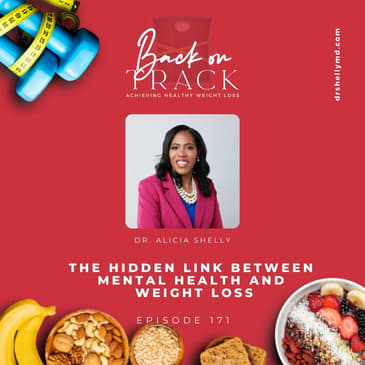
Your mental health is just as important as your physical health—and often, the two are more connected than we realize.
In this episode I emphasize the link between mental health and weight loss. I explain how stress, anxiety, and burnout can raise cortisol levels, leading to weight gain and emotional eating. Also, I offer practical tips for busy individuals, like setting small goals, practicing self-care, and incorporating short workouts and meal prep into daily routines. Furthermore, I encourage listeners to prioritize their mental health, reduce stress, and adopt mindful eating habits to improve both mental well-being and weight management.
If you're ready to improve both your mental health and your weight loss journey, this episode is a must-listen! Hit play now and start making positive changes today.
Episode Highlights:
-
Mental health awareness and weight loss
-
Cortisol's role in weight gain and fat storage
-
Weight loss tips for busy working moms
-
Sustainable changes and overcoming limiting beliefs
-
Incorporating healthy habits into busy lifestyles
-
Stress management and mindful eating
-
Additional mental health strategies
Connect with Dr. Alicia Shelly:
-
Website | drshellymd.com
-
Facebook | www.facebook.com/drshellymd
-
Instagram | @drshellymd
-
Linked In | www.linkedin.com/in/drshellymd
-
Twitter | @drshellymd
About Dr. Alicia Shelly
Dr. Alicia Shelly was raised in Atlanta, GA. She received her Doctorate of Medicine from Case Western Reserve University School of Medicine in Cleveland, OH. Dr. Shelly has been practicing Primary Care and Obesity medicine since 2014. In 2017, she became a Diplomat of the American Board of Obesity Medicine. She is the lead physician at the Wellstar Medical Center Douglasville. She started a weekly podcast & Youtube channel entitled Back on Track: Achieving Healthy Weight loss, where she discusses how to get on track and stay on track with your weight loss journey. She has spoken for numerous local and national organizations, including the Obesity Medicine Association, and the Georgia Chapter of the American Society of Metabolic and Bariatric Surgeons. She has been featured on CNN, Fox 5 News, Bruce St. James Radio show, Upscale magazine, and Shape.com. She was named an honoree of the 2021 Atlanta Business Chronicle's 40 under 40 award. She also is a collaborating author for the, “Made for More: Physician Entrepreneurs who Live Life and Practice Medicine on their own terms''.
Resources:
FREE! Discover the 5 Reasons Your Weight-Loss Journey Has Gotten Derailed (And How To Get Back On Track!) 👉 Click
[00:00:00] Welcome back to the Back on Track Achieving Healthy Weight Loss, where I help you get on track and stay on track with your weight loss journey. I'm your host, Dr. Alicia Shelly. So let's get started.
[00:00:13] Hey, welcome to the Back on Track Achieving Healthy Weight Loss podcast. I'm your host, Dr. Alicia Shelly. So October is Mental Health Awareness Month. I'm not sure if you're aware. I know it's also breast cancer awareness as well.
[00:00:43] But also mental health awareness. And so I really wanted to take a moment and just discuss the importance of mental health. I was talking to a client the other day, and she was just saying to me how difficult it is for her to lose weight because number one, she's super busy, she has work obligations, home obligations, and it's been so hard for her mind to kind of wrap around all the healthy habits that she has to do in order to be successful.
[00:01:12] And so she had mentioned that she doesn't have time to go to the gym. So I offered her, I'm like, well, is there anything you can do at home for physical activity? And she's like, well, I have a whole gym. I just have to get motivated to do it.
[00:01:25] And this is something that I see a lot in my practice, not just her, that sometimes we're so busy in our mind and we don't do everything right, we can't lose weight.
[00:01:37] And so I really wanted to take a moment to kind of discuss the small changes and the small things that we can do to kind of help with battling that burnout, battling the overwhelm, battling anxiety, depression, so that we can be able to lose weight and kind of focus on that mental health aspect.
[00:01:55] But first, let's chat a little bit how mental health impacts weight loss.
[00:02:01] So in prior episodes, I talked about the hormone cortisol.
[00:02:05] So cortisol is a hormone that circulates throughout the body.
[00:02:09] It's what we describe as our stress hormone.
[00:02:12] When cortisol is elevated in higher amounts, especially chronically, because you can see it acutely, like let's say if you see a bear, your cortisol levels will increase, your heart starts to raise fast, and you run away from the bear.
[00:02:27] That's what we describe as the fight or flight complex.
[00:02:31] But if you're having chronic elevated cortisol levels, that can actually lead to more fat storage and weight gain.
[00:02:41] And so it's important that we find ways.
[00:02:44] First of all, we need to not necessarily address the chronic stress that's going on in our lives.
[00:02:49] But then secondly, we need to find ways to kind of help manage that so that our cortisol levels can be more stable and less chronically elevated.
[00:02:57] So let's talk about and some other things too with stress.
[00:03:01] Not only is it just hormonal, but you sometimes can see it in how we react to things.
[00:03:07] I don't know about you, but how many times have you noticed you're going through a stressful situation and you're like grazing more?
[00:03:13] You're not hungry, but you're eating because you're trying to overcome that stress.
[00:03:18] I know I'm guilty of it.
[00:03:20] And sometimes it's just natural.
[00:03:22] So when it comes to anxiety and depression, it can be a vicious cycle.
[00:03:27] I've had many clients where the extra weight makes you feel more depressed and then the depression and anxiety and burnout and makes it worse for you where you don't have the motivation to get up and exercise or the motivation to eat well.
[00:03:44] You just don't have that energy.
[00:03:45] All you want to do is just stay in bed or sit on your couch and you just lose that motivation.
[00:03:51] And so it's just a vicious cycle between depression and weight gain.
[00:03:55] But when you're able to break that cycle by either getting professional help or assistance or treating the anxiety, depression and burnout, what you'll find is that you'll have more energy to make those lifestyle habits.
[00:04:08] You'll see a difference in your weight and it makes a huge difference.
[00:04:12] So it's important that number one, if you're experiencing anxiety, depression, that you seek help to help get through that.
[00:04:19] Now let's move on and talk about what are some weight loss tips for our busy working moms.
[00:04:24] Now the one thing I will say is that there will always, always, always be something on your to-do list.
[00:04:30] You will probably die with something undone.
[00:04:34] It's just what it is.
[00:04:35] We always will have something on our to-do list and that is okay.
[00:04:39] In order to take care of other people, you have to take care of yourself.
[00:04:44] So many people that I see who are taking care of their elderly parents, their spouses, their children,
[00:04:50] and they're like, I just don't have time for me.
[00:04:53] But in order for you to stay sane, you need to make time for you.
[00:04:56] There's never going to be time.
[00:04:58] You always have to make time.
[00:05:00] And so there are some simple self-care practices that you can start to incorporate that may be five minutes, that may be 10 minutes,
[00:05:07] but at least you start.
[00:05:09] And so definitely you can do some mindfulness activities.
[00:05:12] They have different apps like the Calm app.
[00:05:16] They have multiple apps where you can use to help with mindfulness and short meditation sessions to kind of help with just relaxing the body,
[00:05:25] you know, bringing you down from that stressful day.
[00:05:29] Journaling helps kind of writing out your day, having some gratitude practice, writing out what you're grateful for.
[00:05:35] That's actually even better.
[00:05:36] I've tried that and I've realized that I tend to complain a little bit more.
[00:05:40] So by writing it out and journaling, it helps me to remember the good things and appreciate the things that are going on in my life because it could be a lot worse.
[00:05:51] Next, it's going to be important to set boundaries to reduce your stress.
[00:05:56] Sometimes there are some people in your life who will call you and you know it's going to be stressful because they only call you unless something's going wrong.
[00:06:04] And so sometimes you've got to set boundaries and be like, listen, when you call, let's not talk about X, Y, and Z.
[00:06:10] Let's talk about something more uplifting because this is stressing me out.
[00:06:15] And it's okay to let people know that they're stressing you out so that they can make changes too.
[00:06:20] But remember to have set those boundaries to people.
[00:06:23] If they're stressful, you don't have to pick up the phone.
[00:06:25] You can let it go to a voicemail.
[00:06:27] I had one client, she was telling me how every time she called a certain family member, they would just curse her out.
[00:06:34] I'm like, well, don't call.
[00:06:35] You don't have to call or you don't have to pick up the phone if she's going to misuse you like that.
[00:06:41] So make sure you set those boundaries.
[00:06:43] Next thing I would say is that it's important for you to have small, sustainable changes.
[00:06:49] Small, sustainable changes.
[00:06:51] I remember I had this one gentleman and in his mind, you remember when he was 20 and he lost weight by going to the gym two hours daily.
[00:07:01] But now he's a dad, he's, you know, promotions at work.
[00:07:04] He doesn't really have time for two hours daily.
[00:07:08] But he would never go to the gym because he's like, well, I don't have the two hours.
[00:07:12] Sometimes you have to make those small changes.
[00:07:15] Even if you don't have the two hours that you feel is necessary to have a good workout, you still can do something in 10, 15, 30 minutes and be consistent with that than to do two hours once a week or two hours when you remember.
[00:07:30] Because like I said, there's always something on the to-do list.
[00:07:34] So it's important to have small, sustainable changes that you can maintain over time.
[00:07:40] Also, it's important to kind of reduce those limiting beliefs.
[00:07:43] Like I mentioned, the gentleman that thought that if he went to the gym for two hours, he would work out.
[00:07:49] And since he can't do that, he'd mean you can't lose weight.
[00:07:51] So since he can't do that, you know, he's not going to lose weight.
[00:07:55] But I've had patients who are sedentary in wheelchairs lose weight with changing, first of all, how they ate, but then also continue to do the strength training exercise from their chair.
[00:08:06] So it's important that we kind of reduce those limiting beliefs because they are blocking us from getting our blessing and blocking us from moving forward in our weight loss journey.
[00:08:16] Secondly, the other thing I would say too is find ways to fit healthy habits in your busy lifestyle, whether it's having a quick home workout or walking around the mall while other people are shopping.
[00:08:30] Or if you're in the parking lot, park further away and walk further so that you can get your steps in and get your physical activity in as well.
[00:08:39] And the other thing that's going to be important is finding time to meal prep.
[00:08:42] Having that food ready.
[00:08:44] So all you have to do is grab and go makes it a lot easier because sometimes at the end of a busy day, you are too tired to think about what you're going to eat.
[00:08:53] And it's just convenient to go to the local fast food store to get something to eat.
[00:08:57] So it's important that you find time for that meal prepping as well.
[00:09:01] Now, when we look at stress management and physical activity, it's important to incorporate exercise to help.
[00:09:09] In fact, when we exercise, we increase our endorphins that circulate throughout our body that make us feel good.
[00:09:16] So I don't know about you, sometimes I'll exercise and I'm like, man, my body's sore, but I feel good.
[00:09:20] And that's because I'm allowing those endorphins to work and they help me feel good.
[00:09:26] Now, there are some stress relieving exercises that you can do, such as yoga, walking, dancing.
[00:09:33] And if you have like a short timeline, try to put in 10, 15 minutes during the break so that you can get your exercise in.
[00:09:41] And then the last tip I have is mindful eating habits, especially when you're stressed.
[00:09:46] We tend to just graze and eat what's available when we're going through a stressful period.
[00:09:51] One suggestion I give is that you should probably not buy those stressful foods, the cookies and the cakes that can actually cause you to get off.
[00:09:59] But it's important to pack healthy snacks, slow down at your meals, avoiding distractions while eating.
[00:10:07] So they don't recommend watching television while you eat because sometimes you don't realize how much you're eating.
[00:10:12] The other thing is, is it's important to have some intuitive eating where you stop when you're hungry.
[00:10:19] That also is very helpful as well.
[00:10:22] And then some other mental health strategies that you can use is setting realistic goals.
[00:10:27] Making sure that the goals that you're setting are small, that you can achieve and can avoid burnout.
[00:10:33] I had one lady tell me that, you know, at one program she was at, she was doing meal prepping and it got to the point where it was too overwhelming for her.
[00:10:42] That's the last thing we want to do is to help you feel overwhelmed.
[00:10:45] So if you can focus on just the small things, the small goals, it would be better.
[00:10:51] Something that you're able to maintain, which is important.
[00:10:54] Also having accountability and social support.
[00:10:57] Sometimes you may not realize that other people are trying to lose weight and you're like, well, I don't know who can be my support group.
[00:11:04] But it's important to have those accountability patients, people in your life, so that when you are feeling bad, they can help encourage you.
[00:11:12] They can be your accountability partner to make sure you're exercising and doing all the things you want to do.
[00:11:17] And then last suggestion is to avoid emotional eating.
[00:11:21] So recognizing whether you're hungry or you're just emotionally hungry, emotionally hungry.
[00:11:27] Because sometimes we're not really hungry.
[00:11:29] It's just that we're here, we're bored, we're stressed, and so we eat.
[00:11:33] So it's important that we kind of manage those emotional eating.
[00:11:36] In conclusion, we talked about why mental health is so important as far as when it comes to weight loss.
[00:11:44] Because when your mental health is not in a good place, you're not going to feel obligated to want to exercise more or eat better.
[00:11:52] Because you're just tired and you're just burnt out.
[00:11:55] So it's important that we focus on mental health.
[00:11:58] Definitely take some of these strategies that I mentioned about having small, sustainable changes, prioritizing self-care in your life.
[00:12:05] And then also making sure that you're getting that exercise in and having some mindful eating habits as well.
[00:12:12] Well, I thank you so much for joining us on the Back on Track Achieving Healthy Weight Loss podcast.
[00:12:19] If you like this episode, please share with others, like it and subscribe.
[00:12:22] And don't forget to leave a five-star review.
[00:12:25] And we will see you next time.
[00:12:27] Have a great day.