
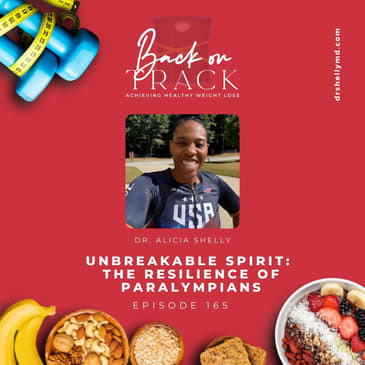
Sometimes, the toughest challenges can become our biggest opportunities for growth.
In this episode of "Back on Track: Achieving Healthy Weight Loss," I talk about how Paralympians, who face huge obstacles, have learned to focus on what they can do, rather than what they can’t. I also share the story of a paraplegic patient who was told he’d never walk again, but he proved everyone wrong. These stories remind us that, no matter the challenge, a positive mindset can change everything.
Join me as we explore how these incredible athletes can inspire us to focus on our strengths, keep pushing forward, and create a new normal on our wellness journey.
Episode Highlights:
-
A patient’s husband shares how his wife overcame paralysis.
-
A brief look at the Paralympics' origins and challenges.
-
Issues like lack of recognition and funding for Paralympic athletes.
-
Stories of Lauren Parker and Rebecca Watts overcoming adversity.
-
Tips on using resilience to overcome obstacles in life and health.
Connect with Dr. Alicia Shelly:
-
Website | drshellymd.com
-
Facebook | www.facebook.com/drshellymd
-
Instagram | @drshellymd
-
Linked In | www.linkedin.com/in/drshellymd
-
Twitter | @drshellymd
About Dr. Alicia Shelly
Dr. Alicia Shelly was raised in Atlanta, GA. She received her Doctorate of Medicine from Case Western Reserve University School of Medicine in Cleveland, OH. Dr. Shelly has been practicing Primary Care and Obesity medicine since 2014. In 2017, she became a Diplomat of the American Board of Obesity Medicine. She is the lead physician at the Wellstar Medical Center Douglasville. She started a weekly podcast & Youtube channel entitled Back on Track: Achieving Healthy Weight loss, where she discusses how to get on track and stay on track with your weight loss journey. She has spoken for numerous local and national organizations, including the Obesity Medicine Association, and the Georgia Chapter of the American Society of Metabolic and Bariatric Surgeons. She has been featured on CNN, Fox 5 News, Bruce St. James Radio show, Upscale magazine, and Shape.com. She was named an honoree of the 2021 Atlanta Business Chronicle's 40 under 40 award. She also is a collaborating author for the, “Made for More: Physician Entrepreneurs who Live Life and Practice Medicine on their own terms''.
Resources:
FREE! Discover the 5 Reasons Your Weight-Loss Journey Has Gotten Derailed (And How To Get Back On Track!) 👉 Click
[00:00:00] Welcome back to the Back on Track Achieving Healthy Weight Loss, where I help you get on
[00:00:05] track and stay on track with your weight loss journey.
[00:00:09] I'm your host, Dr. Alicia Shelly, so let's get started.
[00:00:27] Welcome to the Back on Track Achieving Healthy Weight Loss podcast.
[00:00:31] I'm your host, Dr. Alicia Shelly.
[00:00:34] So for the last week and a half, I have been binge-watching the Paralympics.
[00:00:40] And I've been so inspired seeing the variety of disabilities and how these athletes have
[00:00:46] not let anything limit them in what they're doing in achieving athletically.
[00:00:51] Whether it's they may be having it being visual impaired, where they have a guide running
[00:00:56] with them or whether it is they're swimming without arms or legs and they're just killing
[00:01:02] it.
[00:01:03] They are killing it.
[00:01:04] And so I got really inspired.
[00:01:06] You can't see me, but I am wearing my USA triathlon kit because it just reminds me that anything
[00:01:13] is possible.
[00:01:14] That's the actual, maybe similar to the tagline for I'm in, that anything is possible.
[00:01:20] And the funny thing is you just put your mind to it, you can do it.
[00:01:23] And so I got really inspired to want to talk about just the resilience of the Paralympians.
[00:01:28] Also this week, I was talking to one of my patients' husbands.
[00:01:33] He came with her to the visit and throughout the visit she was saying, yeah, he tells me
[00:01:37] that I just need to keep moving, keep moving.
[00:01:40] And I didn't realize till after I was walking the mail and he was saying, you know, several
[00:01:46] years ago, I actually was paraplegic.
[00:01:49] I had had a work accident where I fractured my neck.
[00:01:52] I could not move my hands or my legs.
[00:01:55] And I went to the Shepherd Center, which is a local rehabilitation center here in Atlanta,
[00:02:01] where he started off with you being in a wheelchair and actually just guiding his wheelchair with
[00:02:07] a straw in his mouth.
[00:02:08] And then from there, he moved on to using a wheelchair, you know, with his hand.
[00:02:13] And then fast forward several years now look at him.
[00:02:17] He is walking and you couldn't even tell.
[00:02:20] I didn't even know that he, unless he had told me that he had this tragic accident
[00:02:25] years before, I would never have known that this man overcame all obstacles because he said
[00:02:31] the doctor's told him he was never going to walk again.
[00:02:33] And now he's walking without a cane at his wife's visit, inspiring her to move forward
[00:02:39] and to keep moving, you know, and to not what he said.
[00:02:42] If you don't use it, you'll lose it.
[00:02:44] So inspiring other people to keep moving.
[00:02:46] And that's just one of the resilience, that mindset of resilience, overcoming adversity,
[00:02:51] overcoming what people are telling you and just focusing on a goal and actually competing in.
[00:02:56] And so that and the Apparel Olympics together inspired me to want to talk a little bit more about it.
[00:03:01] But before we continue, I do want to just maybe talk about kind of what is the Apparel
[00:03:05] Olympics and where did also if you're not familiar with this, let me just share a little
[00:03:09] bit more about the backstory of the history.
[00:03:11] So the Apparel Olympics began as a small event in 1948, originally known as the Stoke
[00:03:17] Mandeville Games.
[00:03:19] It was organized by Sir Ludwig Gutman, who was a neurologist in England.
[00:03:24] And he did.
[00:03:25] He helped injured World War Two veterans rehabilitate through sports.
[00:03:29] And on the same day as the 1948 London Olympics, it featured the wheelchair bound
[00:03:36] athletes competing in archery.
[00:03:38] So that was where they started in archery.
[00:03:39] And if you did watch the Apparel Olympics with archery, there are some people
[00:03:43] that don't have arms and were able to actually put back with just their legs.
[00:03:50] Like they literally picked up the bow from with their foot.
[00:03:54] They put it back and was able to hit like, you know, bullseye right through the
[00:03:59] middle, just with their legs, with no arms, which was amazing.
[00:04:03] Amazing.
[00:04:04] Anyway, and then for those just a quick plug, if you haven't seen the
[00:04:07] Paralympics, it is binging.
[00:04:09] You can get on YouTube.
[00:04:10] I know they have the Peacock app, which has it there.
[00:04:13] So there's other ways where you can binge watch the Paralympics as well.
[00:04:17] If you missed it also, but it really didn't become official Paralympic games
[00:04:22] until the 1960s.
[00:04:24] That's the first Paralympic games are held in Rome, Italy with over 400
[00:04:28] athletes from about 23 countries.
[00:04:31] And it became an international sporting event for athletes with various
[00:04:34] disabilities. The name Paralympics reflects the Greek word para, meaning
[00:04:38] beside or alongside symbolizing its connection to the Olympic games.
[00:04:42] And the one thing I will say by, because this is my first time really
[00:04:46] watching the Paralympics, like I may have seen a couple events over
[00:04:49] the years, but like really, really watching it.
[00:04:52] This was like my first time and I always had to kind of look at this time
[00:04:55] was like, what were people's disabilities?
[00:04:57] Because not all disabilities you see, right?
[00:05:00] Like they have two ways, two arms and they're walking.
[00:05:03] So what's their disability?
[00:05:05] But what I didn't realize is that sometimes people have
[00:05:07] disabilities with weakness of that left hand.
[00:05:10] You know, they may not have the full strength of their leg.
[00:05:13] Some people are visually impaired.
[00:05:14] So it was just amazing to see all the various disabilities and how
[00:05:18] people were able to overcome them to excel at this high level.
[00:05:23] And I mean, and these people weren't just like for the 100 meter race.
[00:05:27] It was like nine seconds.
[00:05:28] But these guys who won the 100 meter race in the different,
[00:05:31] they are like running 11 seconds.
[00:05:33] So literally two seconds off what the Olympics was.
[00:05:36] So these are people at their highest elite training, but maybe they don't have,
[00:05:41] you know, they have an amputation of their leg.
[00:05:44] They have an artificial leg that they're utilizing.
[00:05:46] So it's just amazing to kind of see just how people were able to overcome.
[00:05:52] And then since the 1960s, the Paralympics have grown into a global event
[00:05:56] which is held every four years following the summer and winter Olympics.
[00:06:01] The athletes competing in various sports adapted for different physical abilities.
[00:06:05] And the games have been played as significant role in changing perceptions
[00:06:08] about disability and promoting inclusiveness.
[00:06:11] And there are many challenges that the Paralympics faced,
[00:06:15] such as a lack of recognition and support, especially in the early years.
[00:06:19] The Paralympics struggled to gain recognition from the broader sports
[00:06:22] community and international organization.
[00:06:25] And it wasn't until 1988.
[00:06:27] Now, mind you, the first event was 1948.
[00:06:30] So 1988, 40 years later that the Paralympics became officially linked with the Olympics
[00:06:36] and received the global attention it deserved.
[00:06:39] Well, and then the second challenge was funding issues.
[00:06:42] Securing adequate funding and sponsorships was a significant challenge
[00:06:46] for the Paralympics.
[00:06:47] Many sponsors and governments were hesitant to invest in events
[00:06:50] for disabled athletes, which limited resources for training, travel and proper facilities.
[00:06:55] And that's the one thing we did notice.
[00:06:57] Me and my friends who were watching, they're like, you know,
[00:06:59] when although the US had a huge delegation, definitely, but when you compared it
[00:07:05] to the delegation for the Olympics, it was definitely a lot smaller.
[00:07:10] And you just wonder the different sponsorships that people have
[00:07:13] to kind of help them go because these people actually worked full time jobs.
[00:07:17] There was this Spanish runner or triathlete.
[00:07:20] She won gold in her triathlon disability category and she was blind.
[00:07:25] She was in the I forget exactly the criteria,
[00:07:27] but she was actual doctor.
[00:07:29] She was a doctor in Spain and she's doing this and she ran and I mean,
[00:07:33] she did great. I mean, she won a gold medal in that race.
[00:07:36] And another lady was a nurse and some other people had full time jobs.
[00:07:40] And this is just something they did on the side.
[00:07:42] So it wasn't like they had their whole career to doing the sport.
[00:07:46] They were just focused on, you know, they have another career
[00:07:50] and they do this as, you know, weekend warrior, shall we say?
[00:07:53] The other thing I would say as well is that the one thing
[00:07:56] they were promoting during the broadcast is that some of these athletes
[00:07:59] have now joined regular like going to different universities
[00:08:03] that have a track program.
[00:08:05] They've been included in that track program, which is great.
[00:08:07] And then there is a nonprofit organization called There to Try,
[00:08:11] which focuses on disability triathletes with disabilities.
[00:08:16] And one of the ladies, I forget who it was, she interned there.
[00:08:20] And one of her like when she exited,
[00:08:22] the goal was for her to do a triathlon and she did it.
[00:08:25] And then after the Olympics, actually competing in the track
[00:08:29] on which was pretty amazing.
[00:08:30] So definitely funding issues is important.
[00:08:32] I would say we do need to fund more and we do need to support our
[00:08:36] Paralympic athletes also media coverage.
[00:08:40] Early on, the challenges of Paralympics received minimal media attention
[00:08:44] compared to the Olympics and that hinders the visibility and growth.
[00:08:47] You know, you don't know what you don't know.
[00:08:49] And sometimes, you know, not seeing this on television or knowing
[00:08:53] that it's even going on makes a big difference.
[00:08:56] And so this time, NBC had it on like USA, CNBC channels.
[00:09:00] And they actually did have it on NBC too over the weekends,
[00:09:04] where they were showing that coverage, which was good.
[00:09:06] Also a lot of social stigma and misconceptions about disability.
[00:09:10] Because like I said, there's some people you look at them,
[00:09:12] you wouldn't think they had a disability.
[00:09:14] They do.
[00:09:15] How are they multiple sclerosis or weakness?
[00:09:18] You know, sometimes you can really tell, but other times you can't.
[00:09:21] And so that misconception and social stigma is something we still have to work on.
[00:09:26] And then also finding limited accessibility.
[00:09:29] A lot of times when people and I'll share a story coming up about a lady who was told,
[00:09:33] oh yeah, you have this disability, well, you can't do anything.
[00:09:36] And not realize that there's other options for people to still stay active
[00:09:39] despite their disability.
[00:09:41] I have a young lady who sees me, who has exactly mental disability
[00:09:46] and she has been able to just compete in gymnastics competition
[00:09:50] in the Special Olympics.
[00:09:51] She even, well, unfortunately couldn't make it,
[00:09:53] but was going to go to Belgium to participate in the Special Olympics.
[00:09:57] So we definitely need to support our local Special Olympics in our community.
[00:10:01] But despite these challenges, the Paralympics has grown into a prestigious
[00:10:05] international event, championing both athletic excellence and disability rights
[00:10:09] and making sure that we are aware that we need to have more access
[00:10:13] for people with disabilities and just have and change our misconceptions about it as well.
[00:10:18] I do want to highlight a couple of stories of a few of the Paralympic athletes
[00:10:22] who inspired me.
[00:10:24] So I was binge watching the triathlon, which was a whole eight hour segment.
[00:10:29] But because it was eight hours.
[00:10:31] Well, first of all, there was issues with the water quality of the sign.
[00:10:34] So they had to push it back a day.
[00:10:35] So they had everyone's triathlon event on the same day.
[00:10:40] And so it was like eight hours with all the different categories.
[00:10:43] But one of the most inspiring stories that I heard was from
[00:10:46] the Paralympian Lauren Parker.
[00:10:49] She's an Australian Paralympian, a triathlon who became a paraplegic due to a bike accident.
[00:10:55] In 2017, just days before competing in her first Ironman triathlon,
[00:11:01] she was involved in a devastating bike accident where both her tires,
[00:11:06] she was going at like high speed.
[00:11:08] Like it was like 45 miles per hour.
[00:11:09] She was beast because I'm like, my goodness,
[00:11:12] I don't think I can get to 45 miles per hour.
[00:11:14] But anyway, both her tires bursted and she crashed into a guard rail,
[00:11:19] which left her with spinal cord injuries and paraplegia.
[00:11:23] Despite that life changing injury, Lauren made an incredible comeback as a triathlete.
[00:11:29] So just three years later, she went on to compete at the Tokyo 2020 Paralympics
[00:11:34] where she won a silver medal in the women's wheelchair class, PTAWC class.
[00:11:40] And her resilience and determination made her an inspiring figure in both
[00:11:43] triathlon and Paralympic communities.
[00:11:46] She's also the first Australian to win a Paralympic gold across two different sports
[00:11:51] at the same game since 1976.
[00:11:55] So in the 2024 Olympics, she won two gold medals, triathlon and road race,
[00:12:00] and one silver medal for the Chime Trial in this Olympics.
[00:12:04] Like this woman, I was watching her like she didn't let anything stop her.
[00:12:08] She kept going.
[00:12:09] She was moving forward like she was a series.
[00:12:14] And another Olympian that inspired me was Rebecca Watts.
[00:12:17] She's an elite track lead, a mom and a nurse.
[00:12:21] And she was diagnosed with multiple sclerosis in 2018.
[00:12:26] It affected her ability to walk.
[00:12:27] It affected her ability to use her right hand.
[00:12:29] And then also she had difficulties with her visual processing
[00:12:33] and her cognitive abilities.
[00:12:35] But what most impressed me about her was that she was just like me.
[00:12:40] She's a curvy girl doing triathlon and she was killing it.
[00:12:44] Like she came up first in the 2024 World Triathlon Paracup in Toronto
[00:12:50] and then also in the 2024 America's triathlon Parachampionship in Miami.
[00:12:55] She was second and then for the 2024 World Triathlon Paraseries in
[00:13:00] Oklahoma, she was second.
[00:13:01] And then in 2023, she was second in the US Paratrathalon National Championships.
[00:13:07] Which is amazing!
[00:13:09] The fact that she came up second and now she was in the Paris Olympics is amazing.
[00:13:16] Now she did not medal in her class.
[00:13:18] But what was just the fact that she was able to represent the US was amazing.
[00:13:22] And her story is truly inspiring.
[00:13:24] She said in an interview that she was first diagnosed with multiple sclerosis
[00:13:28] and the providers in the hospital questioned her to plan for a future without enduro sports.
[00:13:34] Up to this point, she was actually a long distance runner.
[00:13:36] Fuck mess up!
[00:13:37] I did marathons before I decided to do triathlon.
[00:13:40] So she just resonated with me.
[00:13:41] But they never discussed with her.
[00:13:43] The doctors never discussed with her adaptive gears, ways, you know, adaptive sports
[00:13:48] that would allow her to still stay active despite her disability.
[00:13:51] And so for her, you know, to go from being used to doing marathons
[00:13:57] to like doing sedentary activities, it was devastating for her.
[00:14:00] And so she vowed that she would find a way to enjoy an active future
[00:14:05] that would focus on asking herself what can you do instead of focusing
[00:14:09] on what she could not do when her changed abilities placed obstacles
[00:14:13] between herself and her goals.
[00:14:15] And she says, I feel more alive now than I've ever felt before.
[00:14:19] Like Emma's oddly enough was the gift I never knew I wanted.
[00:14:23] Wrapped in the ugliest wrapping paper I've ever seen.
[00:14:26] She said, and she also says I could lose my abilities any day.
[00:14:29] So I want to live every day to the fullest.
[00:14:32] And that's just mind blowing.
[00:14:34] The fact that you can see in best as the greatest gift you never wanted
[00:14:39] because it opened up your mind to what else you could do
[00:14:42] and just how powerful your thoughts are, how you can just ask yourself,
[00:14:46] what can I do instead of what can I do and be able to supersede
[00:14:50] everyone's expectations, even the doctors who probably don't really
[00:14:54] do marathons or triathlons and be able to say, Hey, yes, I have this disability.
[00:14:59] Yes, I have these obstacles.
[00:15:00] My abilities have changed, but that is OK.
[00:15:03] I'm going to move forward.
[00:15:04] And the one thing from Rebecca is that there will always be obstacles in our lives.
[00:15:09] But like Rebecca and like these other Pere Levenes, we have the last say
[00:15:14] in what we can do.
[00:15:16] We know that there will always be things that we can focus on
[00:15:20] and not our health, but we need to focus on what we can do instead of what we can't do.
[00:15:25] When it comes to losing weight, there will always be obstacles
[00:15:27] stopping us from doing everything perfectly.
[00:15:31] So whether it's eating right or exercising consistently.
[00:15:34] But if we change how we look at these obstacles, we will be in a better place.
[00:15:39] We'll move forward and we'll see progress in our illness journey.
[00:15:43] And so I want to leave you with one last quote from Rebecca Wasp
[00:15:46] because she was very inspiring.
[00:15:48] And I was again, I'm wearing my trisuit in honor of our USA
[00:15:52] Pere Olympians.
[00:15:54] But her quote is you don't get to tell me what my life's going to be like
[00:15:59] and what my future is going to be like.
[00:16:01] So I'm going to do the best I can to create something different.
[00:16:05] I hope that as we move throughout this week,
[00:16:08] that we all create a different normal in our wellness journey.
[00:16:12] Know that you no one can tell you what you are,
[00:16:16] what your life's going to be and what your future is going to be.
[00:16:18] Only you can paint that picture.
[00:16:20] Only you can paint that brush.
[00:16:22] So make sure that we stop making excuses and overcome the obstacles
[00:16:26] that we face and move forward.
[00:16:29] Thank you so much for listening to this episode of the Back on Track
[00:16:32] Achieving Healthy Weight Loss Podcast.
[00:16:35] If you like this episode, please share it with others.
[00:16:38] And don't forget to like it and subscribe.
[00:16:40] And please leave a five-star review.
[00:16:42] All right, we'll see you next time.