
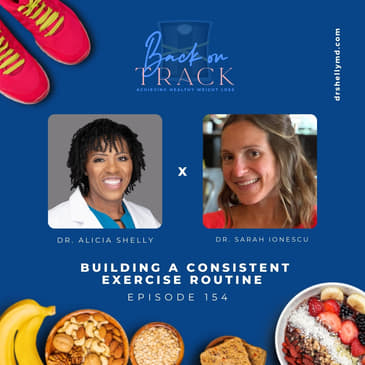
Exercise is beneficial to our health; however, most people don’t have the time and consistency for it.
In this episode, Dr. Sarah Ionescu, a family medicine physician and exercise enthusiast, shared her journey from being a competitive athlete to coping with the challenges of maintaining an exercise routine post-medical school and during family life. She emphasized the importance of exercise for physical and mental health and for role modeling to family and community. Dr. Ionescu discussed overcoming obstacles by starting small, being flexible, and gradually increasing activity. She suggested simple activities like walking and stair climbing to begin with and offered strategies for consistency, such as remembering personal motivations, preparation, flexibility, and celebrating progress.
Start small, stay flexible, and celebrate every milestone. Listen to the full episode now and discover how you can make fitness a consistent part of your routine for a better you!
Episode Highlights:
-
About Dr. Sarah Ionescu's background
-
Benefits of exercise
-
Overcoming obstacles to exercise
-
Types of exercises to start with
-
Strategies for consistency
Connect with Dr. Sara Ionescu:
-
Website | drsaraionescu.com
-
Facebook | facebook.com/drsaraionescu
-
Instagram | @drsaraionescu
-
Linked In | www.linkedin.com/in/drsaraionescu
-
Youtube | @DrSaraIonescu
About Dr. Sara Ionescu
Dr. Sara Ionescu is a board certified family medicine physician, wife, mom of 4, and exercise enthusiast. She is passionate about wellness, preventative care, and exercise and loves to inspire others to move. She strives to stay physically active daily as she sees massive physical and mental health benefits with this and wants to help, inspire and encourage others to do the same!
Resources:
FREE! Discover the 5 Reasons Your Weight-Loss Journey Has Gotten Derailed (And How To Get Back On Track!) 👉 Click
[00:00:00] Welcome back to the Back on Track, Achieving Healthy Weight Loss, where I help you get on track and stay on track with your weight loss journey. I'm your host, Dr. Alicia Shelly. So let's get started. Hi, and welcome to the Back on Track,
[00:00:31] Achieving Healthy Weight Loss podcast. I'm your host, Dr. Alicia Shelly. Now in 2022, one survey noted that 21.2% of men and 19.1% of women in the United States participated in sports, exercise or recreation activities on a daily basis. So if you are doing some sort of physical
[00:00:55] activity, you are doing better than most Americans. So pat yourself on the back. Yeah. Because some people really think about themselves, they're like, oh, I'm not doing the way I should, but you know what, you're doing something. And I know it's difficult because we all
[00:01:08] have different schedules, we all have stuff that's going on. So if you're having difficulty with incorporating physical activity consistently in your lifestyle, this episode is for you. I have Dr. Sarah Ionescu, who is a board certified family medicine physician, wife,
[00:01:28] monopore, and exercise enthusiast. She is passionate about wellness and preventative care and exercise and loves to inspire others to move. She strives to stay physically active daily as she sees massive physical and mental health benefits with this and wants to help inspire and encourage
[00:01:45] others to do the same. So welcome to the podcast, Dr. Sarah. We're so happy to have you. You know, thank you so much. It's wonderful to be here. I appreciate it. So thank you for coming. Now, before we get started, please tell us a little bit more
[00:02:01] about yourself and just kind of how you got into this space. So I like you said, I'm a family medicine physician. I was a competitive athlete growing up. So exercise and physical activity was built into the everyday routine, like didn't even have to
[00:02:17] think about it. I also was an athlete in college. So then fast forward, med school, residency, married kid kind of fell off the exercise train. I didn't really know how to do
[00:02:29] it by myself. And then all these other things came in and, and it really took some time and effort for me to figure out how to become consistent again. And now that I have four kids, I've actually become more consistent than more kids I have, which sounds counterintuitive,
[00:02:45] but I've kind of like figured out what worked for me. And you know, I was still working as a family physician during all this time, but then over the last year or so I kind of transitioned
[00:02:55] to being a stay at home mom. And in the last few months, I realized I kind of got this exercise thing sorted out for myself. And I think maybe I could help other people that are super busy
[00:03:07] and have busy jobs and families and all the things that we all have, help them be more consistent with exercise. And so that's kind of what inspired me to get posting on social
[00:03:18] media and kind of talking all about exercise. And so that's part of why I'm here today. Well, thank you very much. And I think a lot of people are like, what? You can't work
[00:03:28] consistent with more kids. You know, some days are just rough for people. So I'm glad to hear that. And we're going to learn all of the tricks and traits. Don't you all worry.
[00:03:38] So first off, let's just talk about why is it so important for us to even consider incorporating exercise? Like, why can't I just sit on and just be? Absolutely. So I mean, I think most people really know the physical benefits of it. You
[00:03:53] know, we hear about it from doctors and school everywhere that it, you know, helps with your heart health and with your blood vessels and with trying to work on maintaining your weight or losing weight depending on where you are in that. So there's loads of physical benefits
[00:04:08] that I think are very well talked about. I think one area that's not always highlighted is where it helps with your mental health and your mindset, where, you know, just being a practicing physician, I saw so many patients where getting them moving a little bit made
[00:04:25] such a difference in terms of things like depression and anxiety. And just, even if they didn't carry those statistics diagnosing, just helping with their overall mindset and attitude sort of life and towards challenges, it just makes a huge difference. And I've seen that
[00:04:41] in myself as well. So there, I mean, the benefits are boundless. And I think also, especially if you have others in your life, whether it be kids, family members, you can be your role model for them. And that kind of pays it forward. It helps everybody become
[00:04:59] healthier, which, you know, ultimately is so important. Absolutely. I definitely find that when I'm out in nature and either running, walking, I feel so much better. Like my anxiety is lower. You're absolutely right. You just feel like you're in a good place. It just brings up these endorphins.
[00:05:16] Yeah, exactly. Absolutely. Yeah, I'm able to kind of figure out hard decisions that I've been like grasping with and I'm like, so I agree with you on that. Well, what are some obstacles that people
[00:05:30] have to stay consistent or challenges that people have? I know some of my patients have mentioned that it's just, you know, they feel tired, but is there anything that you've noticed? Yeah. I think one thing that I've noticed both for myself and also sometimes patients is
[00:05:46] how you're defining exercise. So, you know, somebody that's a competitive athlete, you're used to having practices better in our two hours long. And so if your definition of exercise is that, it's going to be challenging to find that amount of time to dedicate,
[00:06:02] especially if you have small children, you know, you're a physician, all that stuff. And so I think just taking a moment to redefine it, depending on what your phase of life is. You know, another example is, you know, the guideline says, you should be exercising 30
[00:06:18] minutes five days a week or 40 minutes four days a week. And I at first when I was first out of residency, I was telling patients that and the feedback was like, doc, I'm not moving at
[00:06:29] all. Like that's a lot. When you think about it, if you're not exercising at all, that is a very lofty goal. And so that's when I sort of realized like, Whoa, I need to pump the breaks.
[00:06:39] I need to meet these patients where they are. And if they are not moving, a minute is better than zero minutes. And that's what I used to tell them, like just get moving. And so for me,
[00:06:50] what I realized when I was saying that out loud to them, I wasn't even listening to that advice because if I couldn't find 30 minutes or an hour, I just wouldn't exercise at all
[00:06:58] because it wasn't meeting my definition. And so I think kind of rolling that all up into one, it's really about defining what exercise is for you. And you can always gradually improve,
[00:07:11] you can progress that. But if your goal is so huge that you're just not connected to it, it's going to be really challenging to stay consistent. But if you make that goal, something that you can do, and then keep making it bigger and bigger as you are successful,
[00:07:29] that can really help with the consistency. I love that definitely define what exercise means to you. Now, are there certain exercises that people should be doing? Yeah. So and I mean,
[00:07:42] again, for patients that were not moving much at all, or even for somebody that maybe was a really big exerciser, but life has happened and they've kind of fallen off that path. I always say like
[00:07:55] start super simple. You do not even need fancy, you don't need anything. You can just get up and walk around your house for a minute. If you can navigate fear, you can get up and walk
[00:08:05] up and down the stairs. And again, like as you build your endurance and you build confidence in yourself with getting back to being active, you can increase those activities and the intensity. But I think really just walking just moving if you are not already is a wonderful first
[00:08:23] step because it's low impact, the risk of injury is pretty small. It just gets you going on the right path. I like that definitely walking. And the one thing I would say if it's not safe for you to walk or you know, you don't like to go outside,
[00:08:39] I have some patients that you're like afraid of dogs and then maybe look, you could always do YouTube, you know, things of that nature or different exercises that yeah, up inside to exactly. Absolutely. Well, I love the advice of start where you are
[00:08:53] and kind of move from there. Are there any strategies that you have to help people with staying consistent with their exercise? Yeah, absolutely. So I think the biggest one for me is
[00:09:04] always to remember why you're exercising. And I initially it was like, Oh, I want to be healthy, but I mean, so does everyone like everybody wants to be healthy. So sometimes that is a little too
[00:09:17] like vague and abstract. So I would always encourage patients to sort of think about like, what is it that the exercise is going to help you with? And so I guess an example for myself
[00:09:29] when like my sort of, okay, I need to get back on track here was climbing the stairs carrying my toddler. And at the top being like, like, you know, I was like out of breath, painting,
[00:09:40] it was like, Whoa, I'm young, I like this means to not meet a situation, I need to work on this. And so that was my why when I first got back into exercising. So I think always
[00:09:52] remembering that is really important. I think being prepared can be really helpful. So if you are somebody that's super busy, and you may only have a few minutes to work out whenever
[00:10:04] it is in the day, having the items that you might need ready like a water bottle, your shoes, your clothing, so that those things don't become a barrier, whereas like why have five
[00:10:15] minutes, but by the time I do all these things, the five minutes is gone. You know, take some time from another part of the day to get those items together quickly, though it
[00:10:24] doesn't, you know, get in the way. Another one is being flexible. So if you're somebody that's type A, okay, here's what my workout is going to be for today. But then something pops up,
[00:10:36] you're on call and you get a phone call, a kid wakes up early from a nap, there's some kind of emergency. And the amount of time you thought you had disappeared or is much shorter,
[00:10:46] have a backup plan. So instead of throwing it out the window, I can't do that workout that I had planned. That's okay, you pivot and you be flexible and you go to that backup plan.
[00:10:58] And then the last thing I think is really just celebrating your win. So this was huge for me, because again, as an athlete, you like have all these goals from when you were younger that are
[00:11:09] just not realistic anymore. And so, you know, I would literally write down like did a five minute stretch, class, yay, awesome, and just write it down every day, because then on those days where you're feeling like, oh, I'm not getting anywhere. You go back and you look at
[00:11:23] that list and it's like, Oh my gosh, wait a minute, yes, I am like, look where I was and look where I am now. So those are just some tips that I think can be really helpful
[00:11:32] with the consistency and with getting out there every day. Now if you all missed it, the recap is number one, have a specific why on why you're needing to exercise. Be prepared, make sure you have your gym clothes, make sure you have what you need to exercise.
[00:11:49] And then be flexible if something happens number four, and then number five, celebrate your wins. I like the fact that you created a journal or a list to write down. I have patients like before
[00:12:01] we get started, they'll take a picture, we'll take a picture of them. And then we'll come back and say, Hey, here's where you've changed. And that list does the same thing because it allows
[00:12:09] you to be able to see what you've done and actually probably to help you be, you know, it's a, you won't feel quite as guilty or you won't get down on yourself if you feel like,
[00:12:18] like you said, you feel like you're not meeting your goal. But you were like, yeah, I am doing it. Like I'm starting where I am. I'm taking the first steps there, which is so important because, you know, this goal is to be a lifestyle change,
[00:12:30] like a whole lifestyle change. And there'll be days where it's not going to be perfect, but at least if you were doing something that's something better than 80% of Americans who are exactly, exactly. You're winning. You're winning.
[00:12:47] Exactly. And it helps build that habit, which I think, you know, even if it is just one minute, it's better than not doing anything because then you feel like, Oh gosh, I have a streak going and now it's lost. At least if you do that,
[00:13:00] that minute you have that habit building. Excellent. Excellent. You have it stacking, have it stacking. Exactly. Yeah. Yeah. Exactly. Well, any last minute advice do you have for somebody who's trying to get back on track with their exercise or trying to get started with their exercise?
[00:13:17] Yeah, I think the biggest thing is just give yourself grace. I think, you know, even if you do miss a day, something comes up, something happens. One of the most challenging things to overcome is when you kind of decide, okay, I'm going to start next month
[00:13:33] or next week. It's okay. You know, something happens. It's all right. Just keep doing your best. Keep showing up where you can, when you can and just give yourself that grace of, you know, it's okay. Learn the lesson and then just keep rolling because the hardest thing
[00:13:50] is when you say, okay, next month and you know, you're sort of losing all that time in between. I think if you kind of let yourself, you know, accept that you're trying your best
[00:13:59] and doing your best, that's the key. I like that. I love that. Well, thank you again, Dr. Sarah for coming on. We really appreciate your advice and your strategies and how we can stay consistent with our exercise, our physical activity. Last but not least,
[00:14:16] how often somebody work with you or find you on the internet? Sure. Absolutely. And again, thank you so much for having me. It was so fun. So I have a website where people are interested in this type of, you know, tips, exercise,
[00:14:31] content that Dr. Sarah Ionescu, so it's D-R and then my name, S-A-R-A-I-O-N-E-S-T-U.com. And there you can sign up for my free newsletter. And then I have a YouTube channel where I post long videos and short every single day. And then I also have Instagram and Facebook
[00:14:52] and my handle there are the same as Dr. Sarah Ionescu everywhere. Awesome. Awesome. Well, thank you again for joining us and thank you all for listening and joining us today on the Back on Track Achieving Healthy Weight Loss Fast.
[00:15:07] If you like this episode, please share it with others, like it and subscribe. And don't forget to leave a five star review and we will see you all next time.