
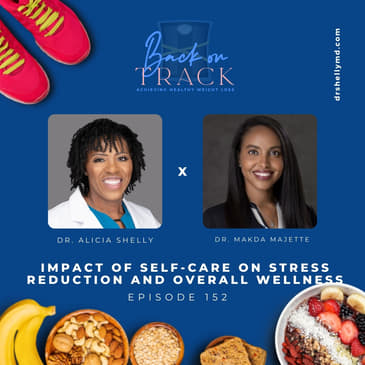
Did you know that stress can significantly impact weight loss and overall health?
In this episode, Dr. Makda Majette, a dedicated family medicine physician, discusses the importance of self-care in reducing stress. With a focus on working moms who face heightened levels of depression and anxiety, Dr. Majette shares practical strategies for incorporating self-care into daily life.
She explains the power of deep breathing exercises and positive self-talk in managing stress, along with the importance of nurturing oneself through small, consistent actions. Dr. Majette emphasizes that self-care is an ongoing commitment to emotional well-being and encourages listeners to prioritize their mental health.
Join Dr. Shelley and Dr. Majette as they explore the transformative impact of self-care on stress reduction and overall wellness. Tune in to discover practical tips for incorporating self-care into your daily routine and reclaiming joy in your life!
Episode Highlights:
-
About Dr. Makda Majette
-
Introduction to stress and its impact
-
Definition and importance of self-care beyond superficial activities
-
Practical self-care strategies
-
Daily incorporation of self-care
-
Advice for beginners on self-care
Connect with Dr. Makda Majette:
-
Linked In | www.linkedin.com/in/makda-majette
-
Instagram | @docmajette
-
Facebook | www.facebook.com/people/Makda-Majette
-
YouTube | www.youtube.com/@docmajette
About Dr. Makda Majette
Dr. Makda Majette is a dedicated board-certified Family Medicine physician with a deep commitment to public health. She earned her Doctor of Medicine from the University of North Carolina at Chapel Hill School of Medicine, and her Master of Public Health from the UNC Gillings School of Global Public Health. She completed her residency at the University of Miami/Jackson Memorial Hospital, where she was honored with a teaching award.
Dr. Majette is passionate about mentorship and has received accolades such as the Emory University 40 Under 40 Award and Brickell Magazine's Top 20 Under 40. She enjoys engaging with high-achieving professionals who need help getting back the feeling of joy in their careers and lives. As a professional speaker, she specializes in topics like self-care, wellness, public health and embracing joy in life.
Resources:
FREE! Discover the 5 Reasons Your Weight-Loss Journey Has Gotten Derailed (And How To Get Back On Track!) 👉 Click
[00:00:00] Welcome back to the Back on Track, Achieving Healthy Weight Loss, where I help you get on track and stay on track with your weight loss journey. I'm your host, Dr. Alicia Shelly. So let's get started. Welcome to the Back on Track, Achieving Healthy Weight Loss podcast.
[00:00:31] I'm your host, Dr. Alicia Shelly. A recent poll noted that 42% of working moms have some type of depression and or anxiety. 42%, this is such a high number, especially when the general population it's at 28% for having depression and anxiety. So that's almost double. And not only does
[00:00:55] depression and anxiety can be worsened by external stressors, having extra stress can lead to increased cortisol levels and waking. So today we are going to talk all about how we can reduce our stress with self-care. And I have expert Dr. Magda Majek. She is a dedicated board certified
[00:01:16] family medicine physician with a deep commitment to public health and mentorship. She enjoys engaging with high achieving professionals who need help getting back the feeling of joy in their careers and lives. As a professional speaker, she specializes in topics like self-care,
[00:01:32] wellness, public health and embracing joy in your life. And she's also the host of the YouTube channel at Doc Majek where she talks all about joy. So if you haven't checked her out,
[00:01:43] definitely check her out. So welcome to the podcast, Dr. Majek. We're so happy to have you. Thank you so much, Dr. Shelly. It's such a pleasure to be here. And thank you for that introduction. Oh, you're very welcome. I'm glad that we're going to have an opportunity to
[00:02:00] learn about how we can decrease our stress, how we can have more self-care in our lives. Because the one question I ask all my patients on that initial visit is what do you do to relax?
[00:02:10] What is your stress level? And there's no really answer of what it is that people do to relax. The only wrong answer is if there's nothing like there's silence when I ask, like
[00:02:20] it's just not good at all because we want you to have an outlet. But before we get into self-care, please tell us a little bit more about yourself and how did you get into the space of
[00:02:31] self-care and joy? Well, I'll tell you a shorter version. But of course, you know, in our lives, our lives, many things happen that determine where we get to as far as our purpose and our careers. But for me, as a family physician, and especially caring for underserved populations,
[00:02:52] so in Miami, I trained at a public hospital, Jackson Memorial Hospital, care for a lot of underserved populations. Then I specialized in HIV primary care as well. So what I had to learn on my own was that my self-care was also so important because
[00:03:13] when you're taking care of a lot of people and you're taking on your stress, but also their stress as your provider when you do have a lot of empathy for your patients and colleagues that are suffering through numerous medical conditions, you can sometimes get to a point
[00:03:32] where you have difficulty caring for yourself because you feel like they need it more than you. Because they have a condition or that of course is much, much more severe than what you personally are dealing with, but you still have to learn to care for yourself.
[00:03:48] So I learned that in a challenging way during the pandemic that I need to make the time to take time to care for myself truly. And it's not just getting my hair done or getting my nails done. It's taking that time to really treat myself well, speak to
[00:04:08] myself kindly, think about things that I enjoy and incorporate that into my life, spend time with people that I'm able to not be stressed with or people that are supportive, like my support system, my family support system and just rejuvenate. So I was able
[00:04:28] to rejuvenate and get to a much better place. And I thought why was I functioning that way before, you know, because you don't realize when you're deep in neglecting yourself, you may not realize how important taking that time to care for yourself and manage your stress
[00:04:48] is. Oh, I agree. Sometimes it's so difficult when you're in that moment because you feel like you need to do other stuff. Like people are asking for your attention, you may have
[00:04:58] family members, you may have work obligations. And it makes it so hard at times to kind of like put yourself first. And then of course, there's some guilt. Well, why do you feel like you've gone through this journey here, especially journey where you like you said, I forgot
[00:05:12] myself, I need to incorporate more self care. Why do you feel like it's important for people to incorporate that self care in their wellness journey? Well, it's so important because when we care for ourselves, we don't care for ourselves just
[00:05:26] so that we care for others, right? We have to care for ourselves because we're blessed with a body and honor the body in our time here on earth that we have, right? Rather than just to
[00:05:40] neglect ourselves and run it down. So it's not just that we care for others, but we need to appreciate ourselves and all that we are. That's true. It is a sign of appreciation.
[00:05:52] And you're also right. We don't have much time on this earth, so we need to enjoy the time that we have and make sure that we are doing things that we enjoy. That's true. Why do you feel like
[00:06:03] people neglect themselves? Or why do you feel like that becomes such a challenge for people? It's so many reasons. Of course, everyone has their own personal reasons why they may have gotten to that point. Ultimately, I think it comes down to feeling thoughts like
[00:06:21] negative thoughts of guilt, shame or blame in regards to like, oh, negative thoughts. Like, I don't deserve to take care of myself or, oh, I'm only useful if I'm doing something for someone else. Or this type of thinking is just pervasive. I don't know exactly where it comes
[00:06:40] from. Maybe as also as women, you mentioned mothers. So mothers have a lot of guilt that they need to put their families before themselves. So that's part of that guilt. And if they do take
[00:06:55] time for themselves, they may feel that, oh, this is time that's going away from my child. If I take a long bath, maybe 30 minute bath, that's time away from my child, even though
[00:07:07] my child can be with her dad or whoever that is. People feel guilty for taking that time for themselves. So that sensation of guilt can be pervasive in many different ways.
[00:07:18] Yeah, so I definitely see how guilt can kind of play a role on how we kind of avoid that self care. Now you mentioned that there are different ways that people can incorporate self-care.
[00:07:30] You said it's more than just getting your hair done and nails done. So tell us, how should somebody be incorporating self-care? And what does that mean? So incorporating self-care, there's very simple things that you can start to incorporate into
[00:07:43] your self-care. Before we go into all of the detail, I wanted to mention first, notice if you're stressed. So sometimes we don't notice when we're stressed and it can become to the point where you're severely stressed. So just take time to notice like,
[00:07:59] huh, are most of my thoughts stressful? Oh, am I feeling like things are not going to go well? Even if I don't have evidence that that's the case, that you are catastrophizing, thinking that, oh, nothing's going to go well. But you don't have evidence that anything has
[00:08:16] gone wrong or you are doing many things that you feel like you're on a hamster wheel. Take time to notice where you are and what you were thinking. And if you are feeling severely stressed, you may need professional help because that can of course lead to
[00:08:32] anxiety and depression. If you have minor stress or you feel like, okay, I have some stressful things going on, but I'm managing to cope on my own. You can start with simple things like deep
[00:08:43] breathing. Every time that you feel your heart rate goes up or you feel like you may have some type of trigger that you want to react to, say someone says something wrong to you or
[00:08:56] you feel offended, right? So if something like that could happen and you're already stressed and someone says, oh, says something and you don't take it the right way. Take a time before you respond. Take some time. Take some deep breath. There's a lot of great breathing
[00:09:11] exercises. One is diaphragmatic breathing. That helps me a lot. So it's taking one hand to your chest, your belly, and then deep breathing in and out. And you can feel your diaphragm, which is your lower abdomen just extend and just take a few times to just,
[00:09:29] you can feel your heart rate come down and try to move your mind, not to what's happening, but to your breath. Like, okay, so I'm just going to focus on my breath right now.
[00:09:38] Or if anything feels too stressful, of course not when you're driving, just take your mind back to your breath. Like wait, I'm breathing kind of fast. Let me just calm down and take
[00:09:49] it some few deep breaths. And then maybe that will give me some time to be more creative and come up with a solution or get help if I need to instead of being reactive. So breathing
[00:10:01] exercise is a great part of self-care. Number two, I would say is how we speak to ourselves. When something goes wrong, I used to do this a lot. Like say even I drop something, oh,
[00:10:14] goodness, I'm so clumsy. Oh, I am, you know, don't say negative things about yourself. And people do it all the time, all the time. Like, oh, I'm bad at this or I'm horrible at
[00:10:29] this. Oh, excuse me. I always late to turn this in. I'm sorry. That's just me. Don't say that that's just you because it's not right. So that is also speaking negatively about yourself. So when you notice yourself doing that, just say no, everybody drops things
[00:10:48] sometimes. I dropped this this one time is does not define who I am, right? Well, taking that time to examine like how am I talking to yourself? Be your own best friend. If you
[00:11:00] notice that you are sitting there dwelling in negativity about yourself, like, oh, I didn't do anything right today. I did this wrong, that wrong, this wrong. Imagine that your voice, that negative voice of you criticizing yourself was you criticizing someone you love, right?
[00:11:18] Your best friend, your grandma. Would you let someone talk to her that way? Yeah, no point. You would be ready to fight, right? So be that vigilant about yourself and about how you talk
[00:11:33] to yourself. So that would be number two, be very vigilant about how you speak to yourself, speak to yourself with kindness and then don't beat yourself up if you don't speak with yourself
[00:11:43] with kindness some days because you're like, oh no, I wasn't kind to myself today. No, no, no. So this is cycle. Right? So it can happen that way too. So just be kind and graceful
[00:11:58] with yourself today. I did my best and today I improved from yesterday and that's okay. I have another day to go and over time, the more you practice it, you will feel so much better about
[00:12:09] yourself. You'll feel so much less stress and you'll have much less guilt and shame about taking care of yourself because you will feel more worthy of being cared for. The better you speak of yourself, the more worthy you'll feel. I like that. So the better
[00:12:24] you think you speak of yourself, the more worthy you'll fear. So if you guys missed it, let me just go through it. So the first one is to focus on deep breathing, try to die
[00:12:33] pragmatic breathing techniques where you put one hand on your heart, one hand on your stomach and take a deep breath. And then number two is stay positive, avoid negative comments about yourself. Number three, be your own best friend, recognize how you talk to yourself. Ask yourself,
[00:12:49] would I talk to a friend like how I'm talking to myself? And if the answer is no, then you need to change. And then also make sure to speak to yourself with kindness. And then last but not
[00:13:00] least, give yourself grace, which is so important. Now, how often should you be incorporating these strategies in your daily activity? Is it a daily thing, weekly thing, monthly thing? How often should you be incorporating these strategies? As much as possible. This is multiple times a
[00:13:19] day. This is from when you wake up in the morning to go to bed throughout your day, if there's a break at work all throughout the day. So if you have to incorporate it every few
[00:13:28] minutes, just incorporate it throughout the day and it doesn't stop. So this is something that just because you did it one day, you're cured and you don't have to do it again. This is something that you have to keep doing and create it as a lifestyle.
[00:13:43] Speaking negatively about yourself, the reactivity, all of those things were a habit and you do that throughout the day. So now it's best to change and incorporate the positive self-talk, the calm nature, the deep breathing and incorporate that throughout the day. And it only takes a few
[00:14:04] seconds, right? It only takes a few seconds to interrupt the thought patterns, but just incorporate it throughout the day as much as possible. Yeah, so of course, you know, we talked about a few key ways to do self-care, but it can be
[00:14:29] different for everyone about how they want to incorporate it. Like your self-care could be going for a walk, could be exercise. It could be making sure you have your doctor's appointment. That's self-care as well. So of course it's not as frequent, but incorporating that is part of
[00:14:45] self-care. So what I would recommend for that person just getting started is pick three things. So we talked about the self-talk, that could be one. So pick three things, write them down and try to incorporate that into your day. Like today I'm going to practice positive self-talk.
[00:15:06] And when I catch myself saying like, oh darn, there you go again, dropping stuff. You always drop stuff. I'm going to say no, I don't always drop stuff. I just happen to drop that one
[00:15:17] item and I can easily pick it up and I'm not going to beat myself up over something so simple as dropping something, which everyone does. Right? So it's taking time to address those in
[00:15:29] the moment. So that's something simple you can already incorporate. So, and these are all free. These are all free by the way, very free steps. That's true. All free that you can do. And you don't need any special equipment. You don't need to do anything particular. It's just
[00:15:45] taking the time to say, look, I'm going to start trying to take better care of myself. Make that decision and start with three things and just go from there. And it doesn't have to
[00:15:56] be that you did it a hundred percent in the day. You just did it more than you did in previous and that's okay. You got to start somewhere. You got to start somewhere. Well,
[00:16:05] how can somebody work with you or how can they reach you if they have more questions? I have Instagram. My Instagram is at DocMajet. I have a YouTube page which is at DocMajet. I have an upcoming podcast called Embracing Joy. It is not released yet,
[00:16:28] but I have some live episodes and then the recorded episodes will be coming out soon. Those are the main areas where you can reach me. You can find me on LinkedIn, Macdamejet on LinkedIn. I'm also on Facebook. Oh goodness, you can find me everywhere.
[00:16:41] You're everywhere. You're everywhere, which is a good sign. Yeah, so you can find me there as well. And this was such a pleasure, Dr. Shelley. Thank you. Thank you so much for coming in and sharing your knowledge, your strategies,
[00:16:56] and how we can take better care of ourselves. So not only are we trying to be more healthy, but we need to be well-rounded with having an emotional spirit as well and being able
[00:17:07] to incorporate that self-care for us. So thank you again for joining us and thank you all for joining the Back on Track Achieving Healthy Weight Loss podcast. If you like this episode, please feel free to share it with others, like it and subscribe,
[00:17:21] and don't forget to leave a five-star review, and we'll see you back next week.