
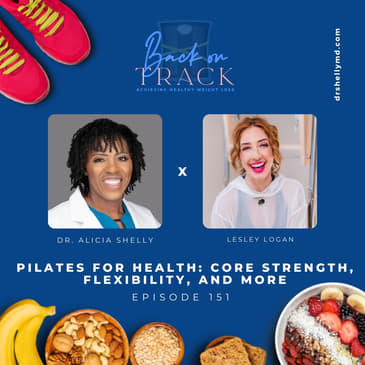
Did you know that Pilates can have many health benefits and will definitely change your body?
In this episode, Lesley Logan, a leading expert on Pilates and co-founder of OnlinePilatesClasses.com, discusses how Pilates can transform lives, especially for those unable to perform high-impact exercises. She shares her journey from skepticism to becoming a passionate instructor after experiencing the significant benefits of Pilates firsthand. She highlights its holistic approach, focusing on stabilizing the torso and preventing injuries by balancing strength and flexibility.
Furthermore, for beginners, she advises starting with online classes or seeking comprehensively trained instructors for in-person sessions, particularly for those with specific medical conditions or recovering from injuries. She underscores the importance of kindness towards oneself and viewing Pilates as a practice rather than striving for perfection.
Are you ready to discover how Pilates can transform your health and body? Tune in to our latest episode featuring Lesley Logan. Listen now and start your Pilates journey today!
Episode Highlights:
-
About Lesley Logan
-
The holistic approach of pilates
-
Health and wellness benefits of pilates
-
Starting Pilates based on individual conditions
-
Tips for beginners on starting pilates
-
Importance of accountability and flexibility in online pilates classes
Connect with Lesley Logan:
-
Website | onlinepilatesclasses.com
-
Facebook | www.facebook.com/onlinepilatesclasses
-
Instagram | @lesley.logan
-
Linked In | www.linkedin.com/in/lesley-logan/
-
Tiktok | @onlinepilatesclasses
-
Youtube | www.youtube.com/@OnlinePilatesClasses
About Lesley Logan
Lesley Logan is the world’s leading expert on how Pilates changed your life, and is the co-founder of OnlinePilatesClasses.com. She has taught thousands of students, trained hundreds of teachers, led workshops at global conferences, and supported companies such as the Associated Press and Balanced Body, empowering participants with movement and happiness through Pilates.
With a comprehensive certificate from the National Pilates Certification Program, and with teaching experience since 2008, Lesley is widely regarded by the Pilates community and corporate executives alike.
Resources:
FREE! Discover the 5 Reasons Your Weight-Loss Journey Has Gotten Derailed (And How To Get Back On Track!) 👉 Click
[00:00:00] Welcome back to the Back on Track, Achieving Healthy Weight Loss, where I help you get
[00:00:05] on track and stay on track with your weight loss journey. I'm your host, Dr. Alicia Shelly.
[00:00:11] So let's get started. Hello, and welcome to the Back on Track, Achieving Healthy Weight Loss
[00:00:32] podcast. I'm your host, Dr. Alicia Shelly. Today, I have expert Leslie Logan, a Pilates expert,
[00:00:40] and she is the co-founder of OnlinePilatesClasses.com. She has taught thousands of students,
[00:00:46] trained hundreds of teachers, and led workshops at global conferences and supported companies
[00:00:51] such as the Associated Press and Balance Body. She's empowering her participants with movement
[00:00:58] and happiness through Pilates. Now I will tell you, I have some patients and some clients
[00:01:04] they just can't go out and walk, and they can't necessarily do the high impact exercises.
[00:01:11] And the one thing I tell them is that, hey, you may not be able to do the high impact
[00:01:15] exercises, but maybe you should consider Pilates. It'll help with strengthening your core
[00:01:20] and other benefits. So without further ado, let us welcome Leslie Logan to the podcast.
[00:01:27] Welcome, Leslie. Oh, I'm so happy. Thank you. Thank you so much for the work that you do
[00:01:31] promoting Pilates. I mean, it really makes me so happy. Usually I'm coming on to tell people
[00:01:36] how great Pilates is, but you already know. We can tell the listeners how it is. But also,
[00:01:40] yes, you guys core strength is so key. Sometimes the high impact stuff isn't even an option
[00:01:45] because we don't have the strength of our center to hold us up and take on the impact
[00:01:49] of those moves. And just because you're doing low impact doesn't mean it's low results or
[00:01:54] low benefits. You know? Exactly. You could get so much from low impact exercise. Well, before
[00:02:01] we get started, tell us a little bit more about yourself and how did you get into the space
[00:02:06] of Pilates? Oh my gosh. So I love telling the story. I used to be embarrassed to tell the story,
[00:02:11] but I love it because hopefully your listeners can resonate. When I was invited to my first
[00:02:16] Pilates class, I actually rolled my eyes. I thought it was BS workout, like infomercial
[00:02:20] workout. Couldn't do the things that said it could do, but I wanted a friend. So I went
[00:02:25] to class and actually I felt parts of my body never felt before. And I left the class so excited
[00:02:32] about the day. I had just so much energy and I was like, Oh my gosh, I'm going to do this every
[00:02:35] single day. So I changed my work schedule so I could. And the more I did it, the more I got
[00:02:39] to know myself even more because you get to pause all the chaos in your brain and just
[00:02:43] focus on what you're doing in that moment and have a movement meditation with yourself.
[00:02:49] And I realized I didn't love my job or where I lived. And so I moved and then I became a
[00:02:54] Pilates instructor. And I happened to live down the street from one of Joe Supplies clients.
[00:02:58] And I got to study with him and his protegees and it became my mentors.
[00:03:02] And I started traveling the world because I was just so passionate about it. And now I've
[00:03:06] taught people all walks of life, all different ages from 11 to 85 and beyond. So it's really
[00:03:13] a blessing really to be able to teach it because I get to help people live the life
[00:03:17] that they want to live. That's amazing. Well, thank you so much for sharing.
[00:03:22] So for somebody who's heard of Pilates, but doesn't exactly quite know exactly what it is,
[00:03:28] how would you describe Pilates? Yeah, it's a great question. So
[00:03:32] Pilates to me is a strength based workout that is designed to balance your imbalances.
[00:03:38] And that means that you are going to get flexibility from Pilates, but it's not just
[00:03:42] a stretch work and it's not just a strength work. So if we go to the weight training,
[00:03:45] for example, that is pure strength. Yoga could be strength, but often people use it for stretch.
[00:03:51] Whereas Pilates is going to be the balance of both. If you are very, very strong,
[00:03:55] we're going to work on flexibility with you and that's how the exercise will affect you.
[00:03:58] And if you are needing strength, you're going to get strength out of it. And if you need both,
[00:04:02] then you're in the best place because you need both things. But it is designed to work the
[00:04:07] entire body from the center first. So we don't spot train in Pilates. We actually work
[00:04:12] everything about connecting the muscles in your center and your center is basically think
[00:04:16] about your torso. It's for anything that surrounds your pelvis to your shoulder girdle
[00:04:20] and the things in between. So that's your back, your front, your sides. And if we can
[00:04:24] stabilize your spine, stabilize your axial skeleton, then we get to challenge you by
[00:04:29] moving your arms and your legs around and see if you can keep those connections.
[00:04:33] Great. So Pilates is the best of both worlds. You have flexibility and you have strength,
[00:04:40] which is important because that's what people need. They need to have that strength to tighten
[00:04:44] up their muscles, tone up their muscles as well as the flexibility. 100%. And also like injuries
[00:04:51] happen when you are too tight. Yeah, they happen and you could be super strong and tight
[00:04:55] and you can be super weak and tight, but tightness is actually where things get torn.
[00:04:59] But then if you're too flexible, then you can have injuries because you fall on a joint
[00:05:04] or you're not staying inside the muscle. So we need both things to prevent injury and
[00:05:08] have longevity in our life. Awesome. Awesome. Well, what are some of the benefits of Pilates?
[00:05:14] I know you mentioned the core strength, but is there anything else? Oh my gosh. Okay. The sky
[00:05:19] is a limit, but the benefits are going to be amazing posture, right? So core strength is
[00:05:24] going to be how posture happens. You shouldn't have to think about your posture. Your body
[00:05:27] should just do it. And when you have good posture, guess what? You also have, you have
[00:05:31] reduced injuries, but also amazing digestion. It also reduces stress. Yes, you guys, if you
[00:05:37] have poor posture, you also going to have not so great digestion. You're going around looking
[00:05:40] for like different pills and things like that, but really you just need to give room for your
[00:05:44] guts. You will have reduced stress, mental clarity. You have better lung capacity because
[00:05:50] you're learning how to breathe and move. We're not holding our breath at any time.
[00:05:54] Flexibility in the muscles and also around the joints. There are moves that actually teach
[00:05:59] you how to get up and down off the ground, which is what's going to increase the length of
[00:06:03] your life and the quality of the life that you live. There's so many more things we can go into,
[00:06:08] but spinal health is a big one. Joseph Plie said, you're only as old as your spine as young.
[00:06:13] And there's a lot of young people with very stiff spines. And then there's also people in
[00:06:19] their eighties and nineties with young spines and they are more youthful because our spines
[00:06:24] need to have mobility and flexibility so that they can take on all that life asks us to do.
[00:06:28] Wow, that's so important. I never thought about it like that. And you're only as young as your
[00:06:35] spine. Well, because I see patients where their spine is worse. They may be in their thirties
[00:06:40] or forties, but they have bulging discs. They have pinched nerves. How does Pilates help with
[00:06:47] multiple types of medical conditions? I know you mentioned it helps with stress, but is there
[00:06:52] something or somebody who's like a good candidate or who should be considering Pilates
[00:06:56] in their daily routine? Yeah. So if you have any aches, pains or injuries, you've been clear to
[00:07:03] move, but you are like a little unsure. So Pilates can't, especially private sessions,
[00:07:07] I would not send you to a class. If you are someone who's coming out of an injury or
[00:07:11] working with a new condition to you, a new to you condition, I would first work with private
[00:07:15] sessions because Pilates really does meet you where you are. And there's different pieces
[00:07:19] of equipment that we can use to help work the rest of your body out. So if you have knee
[00:07:24] or hip replacement, once you've been clear to move, Pilates is going to be one of the best
[00:07:28] places for you to go to learn how to move your body in a balanced way. But if you have
[00:07:32] neurological conditions, Pilates can be one of the best things that you can do because
[00:07:36] there's a lot of stuff that we do lying down. There are people that are Pilates
[00:07:39] instructors, not myself, but there are Pilates instructors who are trained to work with
[00:07:42] Parkinson's other types of conditions to help people, especially with the balance part
[00:07:48] of their body and moving things like that. I personally had a tibia plateau fracture
[00:07:53] and it was non-surgical, but I couldn't put weight on it for eight weeks. And Pilates was
[00:07:57] one of the only things I could do because there's a ton of exercises that do put weight on the leg,
[00:08:01] but there's also a bunch that don't. And so I could literally just remove the ones I couldn't
[00:08:05] do and I could still have a movement practice. You can do it as a pre postnatal person.
[00:08:10] You can do it prenatal. I've had clients do it up until the time they gave birth.
[00:08:14] Depends every pregnancy is different. However, I strongly encourage you to start Pilates before
[00:08:20] you're pregnant. There are some qualified teachers who can work with a person who is
[00:08:24] pregnant in a one-on-one capacity if they've not done Pilates before, but it's better for
[00:08:30] you, the person who's going through the pregnancy to start Pilates beforehand because
[00:08:33] then you'll know what feels different to you as a teacher when not in your body.
[00:08:37] So yeah, there's so many different things that you can do and I think that's what's
[00:08:41] really great about Pilates is it really does meet you where you are with the
[00:08:44] different conditions that can be there. I've worked with people who have had heart conditions
[00:08:49] and things like that where a lot of things they couldn't do MS. We can keep the air,
[00:08:53] we can get the room really cool and actually move your body at the pace that works for you.
[00:08:57] Some conditions I'm going to say most conditions they start with privates first just so that
[00:09:02] you can learn the moves for your body before you go into a group class. But then back
[00:09:06] issues, fusions, stenosis, Pilates can work around those conditions.
[00:09:11] Wow. Okay. Well, that's great. Seems like a lot of people can benefit from Pilates.
[00:09:17] Yeah, I really can. I mean, like I said, I work with 11-year-olds to help them work on
[00:09:21] their coordination and they were getting tall so quickly. They were five, six and 11 years old.
[00:09:27] So we were working on their core strength to help them with their posture because today
[00:09:30] nowadays kids are on devices. Everyone's on devices. You see all these forward heads going
[00:09:34] on. Here's the problem with forward head guys. The more forward your head goes off your spine,
[00:09:38] the more that you see information or people coming towards you as a threat. You don't see
[00:09:42] it as helpful or just being part of society. The other thing about your head going forward
[00:09:47] on your body is it affects your posture, which you already know affects your digestion,
[00:09:51] but it affects your pelvic floor. So even though I'm not a pelvic floor therapist,
[00:09:57] I can see that if the more forward someone's head goes, the more likely they're going to
[00:10:00] have pelvic floor issues and men listening, you have a pelvic floor too. You can have
[00:10:03] issues too. Oh yes. It's not just the ladies. It is not just the ladies. Well,
[00:10:08] is there anybody who should be avoiding Pilates? Yes. So like I said, if you are currently pregnant
[00:10:14] and you've never done it, I personally would, even if your doctor told you to do it,
[00:10:18] I would suggest waiting until afterwards. If you have rods in your spine as opposed to just
[00:10:24] a fusion and on like one spot, I'm going to suggest that you really do work with a
[00:10:29] trained professional in Pilates who works with spinal conditions. Otherwise it might not be the
[00:10:33] best thing for you because you can't flex, extend or twist or side bend. So it can be limiting what
[00:10:40] you can have. Those would be my two tops. Then if you are currently in acute pain as opposed to
[00:10:46] chronic pain, chronic pain, we can work around, but acute pain, acute anything going
[00:10:50] on with a herniation that just happened, you're going to want to wait before you start
[00:10:54] something new just because it's going to be hard to see is the pain that you're feeling
[00:10:59] from your condition or is it from a new movement? It's really important as an instructor,
[00:11:03] you tell me here's the things that I currently have pain on and then I can ask you, is this new
[00:11:09] or is this hard, right? There's a difference between hard and hurt. And we want hard is
[00:11:13] okay. Hurt we don't want. So those are some things. But if you have any neurological
[00:11:17] conditions like water on the brain, there are teachers who are specialized in those things.
[00:11:21] Again, fine teachers are specialized and to help you, you are looking for teachers who
[00:11:26] have at least been comprehensively trained. That word is very important. You'll hear comprehensively
[00:11:31] trained. You should be seeing more than 450 hours next to their certification. They should
[00:11:36] have been trained on multiple pieces of equipment. If you do have conditions that are more high
[00:11:40] risk, I want you to look for someone who has more specialized training. So they have all those
[00:11:44] things I said, plus they've been trained in things that you are working with. Someone who
[00:11:48] has severe scoliosis is going to want to work with someone who's worked with scoliosis before.
[00:11:52] So just keep that in mind. If you're a unique butterfly, find a teacher who's been trained
[00:11:57] to work with you or is willing to work with you and don't go into a group setting if you're
[00:12:01] going through anything right now, just because it could set you up for a setback. And that's
[00:12:05] not what the teacher wants. That's not what you want. Yeah. I love that. I love that. A
[00:12:10] unique butterfly. Yes. Yes. We all get to be unique and some of us just need our little
[00:12:17] more delicate. Well, how does somebody get started if they've never done Pilates before
[00:12:23] and they've been inspired by listening to you? How do they get started? I love this question.
[00:12:28] So if you are an able-bodied person, you've got to make some pains, but not really anything
[00:12:32] that's like medically you need to just get checked in. You can actually start Pilates
[00:12:36] online. You can do something. My full body in 15 workout series has a workshop that Lily
[00:12:42] teaches through the exercises and then a 15 minute class. So you can do it on the floor at
[00:12:47] home on your own. Super awesome. Full body in 15.com. We also have other free mat series
[00:12:52] because you just need room on the floor. If you are someone who's like, I prefer in
[00:12:56] person Leslie, you sound amazing, but I just want to do in person. That's who I am. I
[00:13:00] need that. I totally understand not offended. You can actually look up Pallais near you.
[00:13:05] And again, you're going to want to look for things like comprehensively trained.
[00:13:10] And I do recommend going to a place where they expect you to do an intro session,
[00:13:15] a private session or an intro series or an intro class. If the place lets you as a brand
[00:13:20] new person just go into an equipment class warning red flags, they're there for having
[00:13:27] lots of people come through and not necessarily impact on you. You want places that have rules
[00:13:31] like that actually care about the impact and the benefits you're going to have over their
[00:13:36] bottom line. Of course, they need to make money, their business, but those rules are
[00:13:39] there for a reason. They're there to keep you safe. So that's what I would suggest doing.
[00:13:42] Tanyer L
[00:13:53] Yeah. So first of all, just be kind to yourself. Okay? And also the thing that
[00:13:58] in person offers you is the accountability and showing up in person, which ended up
[00:14:02] having like someone's attention on you. But something about online that's really nice
[00:14:07] is that you don't have to finish the class. So if you are new to moving and new to getting started,
[00:14:12] you can press play. And literally after five minutes, you can go, I'm done. And I did my
[00:14:16] polis today. And that's enough. And that's something that we talk about at online
[00:14:19] polisclasses.com where like finishing is optional. The class is 30 minutes, but
[00:14:22] you never have to finish it. You could do the first five, you know, the first 10.
[00:14:25] So really being kind to yourself and being in practice. And I think polis is important
[00:14:30] to understand polis is a practice, just like being a doctor as a practice. We are in practice.
[00:14:35] And when we're in practice, we get to be curious and we're not trying to be perfect about it.
[00:14:40] And so that means you get to fall off the wagon, you get to miss a couple of days,
[00:14:42] and you can pick back up where you left off.
[00:14:44] Tanyer L And I love it. Well, for those who may not have heard,
[00:14:48] how can somebody work with you? Please tell us.
[00:14:51] Tanyer L Yeah. So online polisclasses.com is where I have free tutorials. It's where
[00:14:55] we have our online classes. It's in the name. And if you are wanting to check out some
[00:15:00] free content, free classes, you can go to opc.me slash challenge. There's a free
[00:15:05] mat challenge in there. And I even think that the full body 15 minute class is also on that
[00:15:09] page. So you can pick the one that works best for you.
[00:15:11] Tanyer L All right. Well, thank you so very much, Leslie, for telling us everything
[00:15:16] that we need to know so that we can get started with pilates.
[00:15:20] Leslie L Yeah. Also just get started.
[00:15:22] Tanyer L That's right. Just take one step forward. Well, thank you again for coming and
[00:15:27] thank you all for joining us on the Back on Track, Achieving Healthy Weight Loss podcast.
[00:15:33] If you like this episode, please share with others, like it and subscribe. And don't forget
[00:15:38] to leave a five star review and we'll see you all next time. Have a great day.