
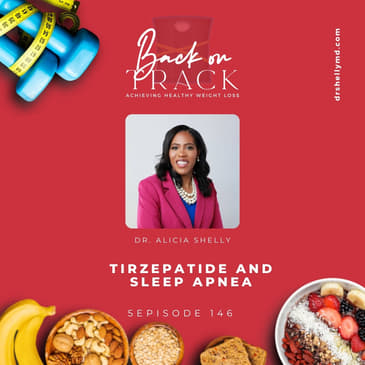
Are you aware of the existence of sleep apnea and its potential impact on our health? Sleep apnea is indeed dangerous; according to researchers, it may be a potentially serious sleep disorder in which breathing repeatedly stops and starts.
In this episode, I discussed sleep apnea and Tirzepatide. I also addressed obstructive sleep apnea, noting its risks linked to obesity, such as interrupted breathing during sleep and various health complications if left untreated. Factors like heart disease and hormonal changes can elevate the risk of developing sleep apnea. Diagnosis involves sleep studies like polysomnography or home tests to assess severity through the Apnea-Hypopnea Index (AHI). Treatment options include CPAP or BiPAP machines to maintain oxygen levels and improve breathing. Alternative therapies like Inspire surgery are available for those intolerant of CPAP.
Tune in to learn more about managing sleep apnea and its associated risks! Listen to the latest episode now!
Episode Highlights:
-
Differentiating between obstructive and central sleep apnea
-
Common symptoms indicating the presence of sleep apnea
-
Sleep studies to diagnose sleep apnea
-
Impact of Tirzepatide on reducing AHI levels and aiding in weight loss for individuals with sleep apnea
-
Future implications and research about Tirzepatide
Connect with Dr. Alicia Shelly:
-
Website | drshellymd.com
-
Facebook | www.facebook.com/drshellymd
-
Instagram | @drshellymd
-
Linked In | www.linkedin.com/in/drshellymd
-
Twitter | @drshellymd
About Dr. Alicia Shelly
Dr. Alicia Shelly was raised in Atlanta, GA. She received her Doctorate of Medicine from Case Western Reserve University School of Medicine in Cleveland, OH. Dr. Shelly has been practicing Primary Care and Obesity medicine since 2014. In 2017, she became a Diplomat of the American Board of Obesity Medicine. She is the lead physician at the Wellstar Medical Center Douglasville. She started a weekly podcast & Youtube channel entitled Back on Track: Achieving Healthy Weight loss, where she discusses how to get on track and stay on track with your weight loss journey. She has spoken for numerous local and national organizations, including the Obesity Medicine Association, and the Georgia Chapter of the American Society of Metabolic and Bariatric Surgeons. She has been featured on CNN, Fox 5 News, Bruce St. James Radio show, Upscale magazine, and Shape.com. She was named an honoree of the 2021 Atlanta Business Chronicle's 40 under 40 award. She also is a collaborating author for the, “Made for More: Physician Entrepreneurs who Live Life and Practice Medicine on their own terms''.
Resources:
FREE! Discover the 5 Reasons Your Weight-Loss Journey Has Gotten Derailed (And How To Get Back On Track!) 👉 Click
[00:00:00] Welcome back to the Back on Track, Achieving Healthy Weight Loss, where I help you get
[00:00:05] on track and stay on track with your weight loss journey. I'm your host, Dr. Alicia Shelly.
[00:00:11] So let's get started. Welcome to the Back on Track, Achieving Healthy Weight Loss podcast.
[00:00:33] I'm your host, Dr. Alicia Shelly. So approximately 39 million US adults have
[00:00:40] obstructive sleep apnea, and 936 million adults worldwide are estimated to have mild to severe
[00:00:49] obstructive sleep apnea. Now, obstructive sleep apnea is a common condition where the upper airway
[00:00:56] becomes blocked while sleeping, and one of the most common risk factors for obstructive sleep
[00:01:02] apnea is obesity. So it was no surprise to me when I learned that last week there was a press release
[00:01:11] about a study looking at terzepatide, which is the generic for manjarro and zephan,
[00:01:17] and sleep apnea. But before we get to that press release, let's learn a little bit more
[00:01:23] about what sleep apnea actually is. Now, there are two types of sleep apnea. Obstructive
[00:01:29] sleep apnea, which is when the upper airway becomes blocked during sleep and interferes with
[00:01:35] breathing. And then you have central sleep apnea. And that's when the muscles and nerves
[00:01:41] aren't activated enough for breathing while asleep. And it can cause pauses in airflow.
[00:01:47] Now, and the reason why we care about sleep apnea is because if untreated, sleep apnea can
[00:01:55] increase your risk for insulin resistance, type 2 diabetes, high blood pressure,
[00:02:02] abnormal cholesterol levels, high blood sugar, stroke, kidney disease, sexual dysfunction,
[00:02:09] coronary artery disease like heart failure and age refibulation. So it can cause a lot of medical
[00:02:16] problems just because it's untreated. And you know what? There are many health conditions
[00:02:22] that can increase the risk of sleep apnea, such as hypothyroidism, cleft lip or cleft palate.
[00:02:29] Heart disease can make it worse, kidney disease can make it worse,
[00:02:33] large tonsils can make it worse, having obesity or higher weight, PCOS and even menopause
[00:02:41] can increase your risk for sleep apnea just due to the changes in the hormone
[00:02:46] that impact the weight and upper airway anatomy. So there are many things that can put you at risk.
[00:02:53] Now, how do you know if you have sleep apnea? Well, some of the most common symptoms are just
[00:02:59] excessive daytime sleepiness. You go to sleep, you wake up and you feel like you didn't sleep,
[00:03:05] like you just wake up unrested. You can have loud snoring. I know I went camping and I heard
[00:03:12] all types of loud snoring, so it can happen. But then you can have observed episodes of just you
[00:03:18] stop breathing where you're sleeping and then all of a sudden you're like, oh, and then you may,
[00:03:23] somebody may have to nudge you for you to wake up, for you to breathe again, or you may wake
[00:03:28] up gasping or coughing. And then sometimes people may have a dry mouth or sore throat when
[00:03:33] they wake up in the morning. And then people can have morning headaches as well. And sometimes
[00:03:39] we notice that people may have or suspect they may have sleep apnea if their blood pressure is
[00:03:44] really hard to control. That can be another increased risk or common symptoms for sleep
[00:03:50] apnea. Now, let's say if you want to be diagnosed or you're trying to diagnose with
[00:03:54] sleep apnea. Well, the first thing is to get diagnosed, you need to do a sleep study. And
[00:03:59] so they have several types of sleep studies. The most common one is when you go into the
[00:04:04] sleep clinic, and they have you sleep there overnight, they put leads on your head, oxygen,
[00:04:10] put something on your chest to check your heart or check your breathing, make sure your
[00:04:15] oxygen levels okay, and to check your brain waves. So that's the most common one. And
[00:04:20] that's called your polysomnography. But then they have one where you can go home or a home
[00:04:24] sleep test where you do it in your bed. And that one doesn't have all the leads, but usually
[00:04:30] they'll either have a watch or they put a lead around your chest and something in your nose to
[00:04:35] check your oxygen and something on your finger. So it just depends, there's many different ones
[00:04:39] out there. But that one is a little bit easier because it's in your bed. And because it's
[00:04:43] portable is a little bit less expensive. Sometimes depending on insurance, these tests can be a
[00:04:48] little bit pricey, but it just depends on the insurance too. But once you get the sleep
[00:04:54] study, they look at this number called the hypoapnea index. And so this index actually
[00:05:03] will diagnose you whether you're mild, moderate or severe sleep apnea. And it measures the
[00:05:08] number of times that your breathing was stopped or hindered you as you sleep.
[00:05:14] And so the difference between so you can have mild sleep apnea if your AHA is between five
[00:05:22] and 14. Between that range, you may just feel maybe a little bit tired, feel a little asymptomatic.
[00:05:29] But when you go up to the moderate level, which is 15 to 30 events per hour, then you
[00:05:35] can have a lot of occasional daytime sleepiness where you're falling asleep while driving,
[00:05:41] you may be sitting in your chair recliner after eating a meal and you're like knocked out.
[00:05:46] Yeah. So that would be more your moderate. And then the severe is when your events per
[00:05:53] hour is greater than 30. And that is interfering with your normal daily activities, your waking
[00:06:00] up just feeling like you ran a marathon during your sleep. Sometimes it can be hard
[00:06:04] to focus during the day, you have morning headaches, your blood pressure is out of
[00:06:08] control. And so that's when definitely you need to get treated. And so how they treat
[00:06:15] sleep apnea is actually through using a CPAP or a BiPAP, depending on which one you need.
[00:06:22] And this is a machine that is like either a mask or they have like the different nasal prongs
[00:06:28] or they have different ones out there and you wear it at night time and it's giving
[00:06:33] you oxygen so that your oxygen level is not dropping while at night and the pressures like
[00:06:38] it's giving you pressure. So sometimes people can find it a little much because there's a lot of
[00:06:42] air coming at you, but I have to admit the patients that stick with it at least,
[00:06:47] at least a good month, they start to feel better. They don't feel quite as tired.
[00:06:53] They feel like, okay, I'm getting the oxygen I need. I'm getting the sleep that I need.
[00:06:56] So if you suffer with sleep apnea, definitely keep with the CPAP, talk with your sleep
[00:07:04] specialist, talk with your primary care doctor if it's not working for you so they can maybe
[00:07:08] find a way to help. And then also too, there is a surgery called the Inspire where they can place
[00:07:15] that in your body to help with sleep apnea without having to do the mask. So you can talk
[00:07:20] to your sleep specialist for that information. Now, if you're concerned based on what we talked
[00:07:26] about, that you may have symptoms of sleep apnea, then I definitely recommend that you
[00:07:32] talk with your provider about getting you the sleep study and ordering that for you so
[00:07:36] that you can see where you are. Sometimes it's good just to know where you sit. Now,
[00:07:41] now that we learned a little bit more about what sleep apnea is and how they calculate it,
[00:07:45] let's talk a little bit about this press release. So in this press release,
[00:07:49] it talks about this international study that looked at over 469 participants.
[00:07:55] And these were adults living with moderate to severe obstructive sleep apnea,
[00:08:00] and they had obesity. Now, the first study looked at adults who had moderate to severe
[00:08:05] sleep apnea, but they did not want to be on a CPAP or unable to get on a CPAP. For the last
[00:08:11] couple of years, the CPAP had been on backorder. So a lot of people that wanted to get on it,
[00:08:16] they weren't. So those people who were unable to do this. And so they looked at what
[00:08:21] happened over a span of 52 weeks or one year to see what would happen as far as with their
[00:08:27] sleep apnea. And so some individuals were on the terzepotide, and terzepotide is the generic
[00:08:34] for manjarro and zeppon. Half of the other part were on placebo, basically taking a sugar shot.
[00:08:39] And so what they noted at the end of that 52 weeks was that their AHI number was reduced
[00:08:47] by 55% with those who took terzepotide versus 5% of those who took the placebo shot. Like,
[00:08:56] amazing. So they basically decreased their AHI by 55%. So imagine if they had like an AHI of 30,
[00:09:07] it made them go from severe to moderate. And if they were in that moderate range,
[00:09:11] went from moderate to mild. And so that is amazing because a lot of people, I mean,
[00:09:17] it's a lot bad to carry this mass, especially if you go traveling and things of that nature,
[00:09:22] but it's almost reducing your risk of having sleep apnea. And when they looked at the average
[00:09:28] weight loss, it was like 18.1% with those taking terzepotide versus 1.3% of those taking the
[00:09:36] placebo. So definitely terzepotide was really helping people to lose weight.
[00:09:41] Now, the second study looked at people who were already on a CPAP machine and to see how
[00:09:48] terzepotide worked for them. And so once again, they had them same similar study. They just had
[00:09:54] people who were taking terzepotide and a group of people who were taking the placebo shot.
[00:09:59] And after that 52 weeks, they noted that their AHI was reduced by 62.8%
[00:10:08] versus 6.4% with placebo. So it was even higher with the terzepotide as far as the
[00:10:15] reduction of their AHI with the CPAP versus 6.4% of those with placebo. And the average weight
[00:10:22] loss of those taking the terzepotide was 20.1% weight loss, which is what it is normally if you
[00:10:29] normally were to take the 15 milligram. And they only did 10 and 15 milligram doses in this
[00:10:33] study. But what's so impressive is that in this study, people were able to not only lose
[00:10:40] weight, but they were able to improve their sleep apnea, which of course, improved their risk of
[00:10:46] high blood pressure, kidney disease, heart disease, atrial fibrillation, all the things
[00:10:50] that I just mentioned earlier, which is number one, making people be able to have less medical
[00:10:55] complications, live better and be able to live a more healthier life. Now we still need to
[00:11:02] wait for the full study to come out. This was a press release, but it's so reassuring to
[00:11:07] know that terzepotide can help adults improve their sleep apnea and allow them to have a better
[00:11:13] night's rest. Because oh my gosh, how many of us need to get a good night's rest? I know I do,
[00:11:19] and I feel so much better when I do. So I hope this helps. We'll see what happens in the future.
[00:11:25] I know terzepotide is being studied in other different medical conditions like fatty liver,
[00:11:30] PCOS. So it'll be really nice to see the effect and how it can help others live a more healthier
[00:11:37] and have a better life. So I thank you again for joining us on the Back on Track, Achieving
[00:11:44] Healthy Weight Loss. If you liked this episode, please share with others, like it and subscribe,
[00:11:49] and don't forget to leave a five star review, and we'll see you next time.